Build a clear, defensible measurement uncertainty process—without starting from scratch
A practical ISO/IEC 17025 toolkit with an automated Microsoft Excel calculator, calibration and testing examples, editable resources, and review checklists.
Secure checkout through Kajabi · Immediate access after purchase
Your uncertainty budget has to produce a result your laboratory can explain
The challenge is connecting method evidence to the contributors, conversions, calculations, and records that support the final reported uncertainty.
What belongs in the budget?
The measurand and relevant contributors depend on the method, equipment, environment, evidence, and intended use of the result.
How should the evidence be used?
Reference certificates, repeatability studies, resolution, recovery, bias, and other inputs may require different conversions and sensitivity factors.
Can someone review the work later?
A defensible process makes the laboratory’s inputs, assumptions, calculations, technical review, and retained records visible.
A structured starting point for the complete workflow
The Starter Kit brings the calculation, documentation, examples, review tools, and training record together in one practical resource.
Tools for calculating, documenting, reviewing, and training
Each resource has a specific role in helping your laboratory create a more organized and reviewable measurement uncertainty process.
Automated Excel calculator
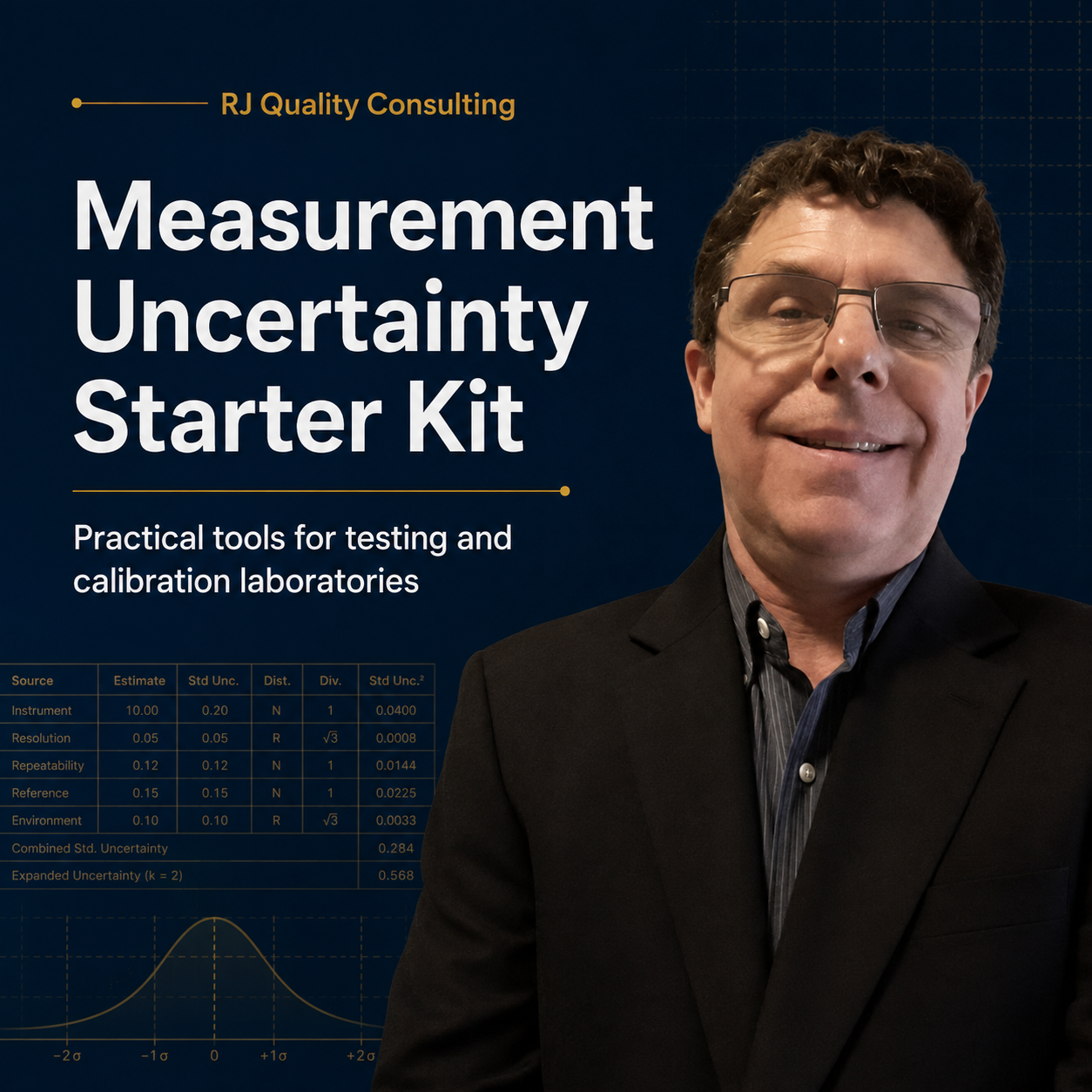
Organize common contributors, perform defined conversions and calculations, calculate combined and expanded uncertainty, and identify the largest contribution.
User guide and quick reference
Follow the calculator workflow, understand the input fields, and reference common distribution and divisor choices as you work.
Calibration worked example
See an illustrative budget built around evidence commonly encountered in a calibration laboratory.
Testing worked example
See how a testing-laboratory context may organize method precision, reference materials, recovery, bias, and related evidence.
Editable procedure template
Customize a documented framework for responsibilities, budget development, review, reporting, records, and change control.
Contributor-identification worksheet
Work through potential uncertainty sources before deciding which contributors belong in the laboratory’s method-specific model.
Readiness and records checklists
Review the budget, supporting records, approvals, reporting approach, and evidence that should remain available for internal or external review.
Guided learning and competency resources
Use concise written lessons, a calculator walkthrough, and an editable training and competency record to support implementation.
Move from evidence to a documented result
Identify and evaluate
Define the measurand, review the method, and use the worksheet to evaluate potential uncertainty contributors and supporting evidence.
Calculate systematically
Enter technically justified inputs, apply the appropriate conversions and coefficients, and review the calculated contributions.
Document and review
Use the procedure, checklists, and competency record to make the process easier to maintain, explain, and independently review.
Because testing and calibration evidence can look different
The underlying uncertainty principles are shared, but laboratories may rely on different data sources and technical considerations.
Calibration example
Illustrates how a calibration-style budget may draw on evidence such as:
- Reference-standard certificates
- Resolution and repeatability
- Stability, uniformity, and drift
- Environmental influences
Testing example
Illustrates how a testing-style budget may draw on evidence such as:
- Method precision information
- Reference materials and calibration data
- Sample preparation and recovery
- Bias evidence and instrument effects
Important: The worked examples are illustrative. Your laboratory must evaluate its own methods, measurands, contributors, evidence, assumptions, and intended use.
The calculator supports technical judgment—it does not replace it
The strongest uncertainty process combines dependable calculation tools with competent, method-specific evaluation.
Designed to help your laboratory
- Organize common contributors and supporting records
- Convert common inputs to standard uncertainty
- Apply sensitivity coefficients
- Combine uncorrelated contributions
- Calculate expanded uncertainty
- Identify the largest contribution
- Flag incomplete information and basic quality-control concerns
Still requires laboratory judgment
- Defining the correct measurand
- Identifying every method-specific contributor
- Evaluating correlation between inputs
- Constructing nonlinear or advanced models
- Selecting specialized coverage approaches
- Approving the budget for use
- Demonstrating conformity with applicable requirements
Is the Starter Kit right for your laboratory?
This toolkit is a good fit if you:
- Work in a testing or calibration laboratory
- Need a structured starting point for uncertainty budgets
- Want calculation and documentation resources together
- Are improving an existing measurement uncertainty process
- Are preparing records for internal review or an assessment
- Understand that the materials must be adapted to your laboratory
This is not intended to be:
- Software that makes technical decisions for your laboratory
- A complete measurement uncertainty statistics course
- A universal model for every method or discipline
- A substitute for competent personnel or independent review
- A guarantee of accreditation or assessor acceptance
Practical resources shaped by real laboratory quality experience
Ralph Martin is the founder of RJ Quality Consulting, an experienced ISO/IEC 17025 assessor, and a quality professional with more than 30 years of laboratory quality-system experience.
His background includes 18 years as a laboratory QC manager, helping laboratories develop and improve their management systems, and evaluating laboratory evidence from an assessor’s perspective.
The Starter Kit translates that experience into a practical framework your laboratory can review, customize, validate, and control.
Start with an organized framework instead of a blank spreadsheet
You receive the calculator, completed examples, user guidance, editable procedure, worksheets, checklists, training record, and concise written lessons in one Kajabi product.
- Built for testing and calibration laboratory contexts
- Calculator designed for Microsoft Excel
- Editable resources for laboratory-specific customization
- Immediate access through your Kajabi account after checkout
Questions before you purchase
Is this for testing laboratories, calibration laboratories, or both?
Both. The kit includes one completed calibration-style example and one completed testing-style example. Each is illustrative and must be evaluated against your laboratory’s actual methods and evidence.
What software is required?
The calculator is designed for Microsoft Excel. Compatibility with Google Sheets, Apple Numbers, or other spreadsheet applications is not promised.
Will the calculator identify all uncertainty contributors for me?
No. The contributor-identification worksheet can help structure your evaluation, but competent laboratory personnel must define the measurand and determine which contributors are relevant to the specific method and application.
Can the calculator handle correlation, nonlinear models, or every coverage-factor situation?
The calculator is intended as a practical workflow for common uncorrelated contributions and defined calculations. Correlated inputs, nonlinear models, specialized coverage approaches, and other advanced situations require separate technical evaluation and may require additional tools.
Are the procedure and worksheets ready to use without modification?
No. They are editable starting resources. Your laboratory should customize them to its scope, methods, responsibilities, terminology, approval process, records, and document-control system before use.
Is this a complete measurement uncertainty statistics course?
No. This is a practical starter toolkit with concise written guidance, examples, and implementation resources. It is not intended to cover every statistical model or advanced measurement uncertainty application.
Does purchasing the kit guarantee accreditation or assessor acceptance?
No. Accreditation and assessor acceptance depend on your laboratory’s scope, methods, technical decisions, implementation, records, competency, and conformity with applicable requirements. The kit supports your process but does not provide accreditation, certification, or technical approval.
How will I access the materials?
After checkout, you will access the lessons and downloadable resources through your Kajabi account.
Make your measurement uncertainty process clearer, more organized, and easier to review
Get the calculator, two laboratory examples, editable resources, review checklists, and implementation guidance in one practical toolkit.
Get the Starter Kit — $97 One-Time