ISO 17025 Accreditation Cost: Real Lab Budgets & Tips
Trying to pin down the real ISO 17025 accreditation cost? Yeah, it’s tricky. The total cost of ISO/IEC 17025 accreditation usually ranges from several thousand to tens of thousands of dollars, depending on your lab’s size, scope, and readiness. You’ll end up budgeting for application fees, on‑site assessments, training, quality management system setup, and those ongoing surveillance audits that just keep coming.

The pricing can feel all over the place because every accreditation body and consultant seems to have their own way of charging. How many tests or calibrations you run, how skilled your team is, and how much outside help you bring in—these all change the final number. If you plan carefully, though, you can keep your costs in check without cutting corners and reap the benefits of ISO 17025 accreditation.
If you invest thoughtfully in accreditation, you’ll boost your lab’s credibility and probably see some long-term gains in efficiency too. Once you really get what’s driving the cost—and where you can actually save—you’ll get compliant faster and avoid those budget headaches later.
Key Takeaways
- ISO 17025 accreditation cost depends on lab size, scope, and readiness.
- Planning and understanding cost components reduce unnecessary spending.
- Smart budgeting and support from experts keep accreditation efficient and reliable.
ISO 17025 Accreditation Cost Walkthrough Video (2026 Budget Guide
If you’re trying to budget for ISO/IEC 17025 accreditation, the cost can feel vague until you see what actually drives it. In the video below, I walk you through the main cost buckets—accreditation body fees, assessor time, travel, surveillance audits, and the internal time it takes to prepare—so you can build a realistic budget for 2026. Watch the walkthrough, then use the rest of this article (and the cost table) to estimate your own range based on your scope and readiness.
Why ISO 17025 Accreditation Cost Feels Confusing
Honestly, ISO 17025 accreditation costs can be confusing. Different accreditation bodies have different pricing models—some go with a flat rate, others bill per assessor-day. The total depends on how many assessors show up, how far they have to travel, and how complicated your lab’s testing scope is. Smaller, focused labs usually pay less than sprawling, multi-site operations.
Location matters, too. UKAS (UK), ANAB (USA), and NABL (India) all have their own fee schedules, travel policies, and assessment cycles. Two labs with the same standard could end up with wildly different invoices.
Here’s a quick table for context:
| Factor | Possible Range (USD) | Notes |
|---|---|---|
| Application Review Fee | 500–1,500 | Paid once with submission |
| Assessor-Day Cost | 400–800 per day | Varies by assessor and duration |
| Annual Surveillance Visit | 1,000–3,000 | Required to maintain accreditation |
| Travel and Logistics | 300–1,000+ | Based on distance and location |
And don’t forget the hidden costs. Prepping documentation, calibrating equipment, or training your team takes time and money, but you won’t see those numbers in the official quote. These internal expenses can eat up a big chunk of your total ISO 17025 certification cost. If you break down each piece, you’ll get a much clearer picture and avoid those nasty financial surprises.
Main Cost Components Of ISO 17025 Accreditation
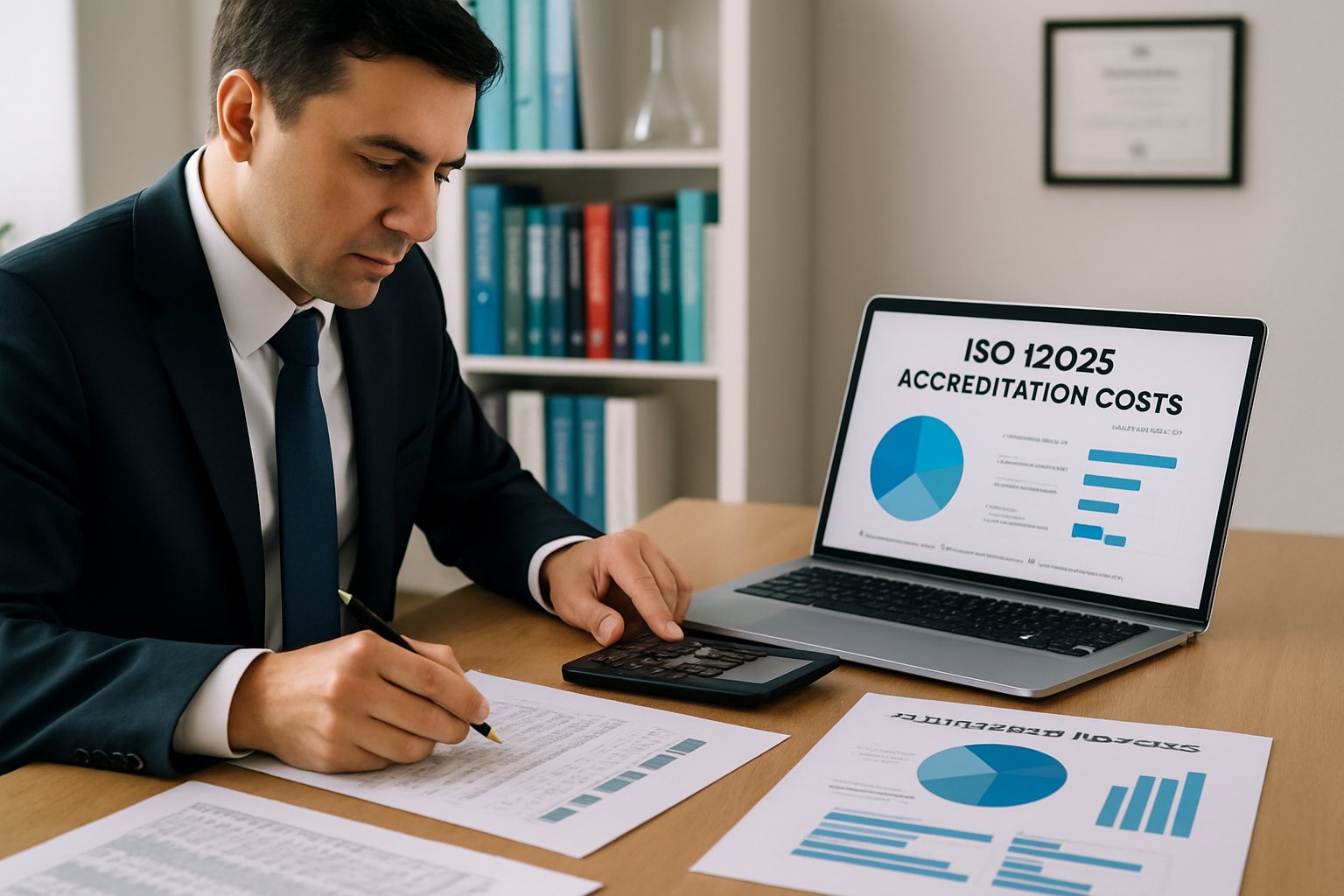
You’ll spend most of your budget on accreditation body fees, assessments, staff training, and verifying competence. Don’t overlook your own internal labor and the ongoing work it takes to maintain compliance systems for valid, traceable results.
Accreditation Body Fees
Accreditation body fees cover the application, document review, and certification audit stages. You pay these directly to whoever handles your external assessment. Most labs spend somewhere between USD 3,000–10,000, but that really depends on your lab’s scope, how many disciplines you’ve got, and how many sites you’re juggling.
Usually, these fees include document evaluation, scope drafting, and admin time. Sometimes you’ll see extra charges for travel, assessor hours, or follow-up reviews after you fix nonconformities. Always ask for a clear, itemized quote up front. Small labs with a limited testing scope might even land a discount.
Make sure your quote spells out daily assessor rates, travel, and any flat application fees. It pays to compare a few ILAC MRA signatories so you’re not paying for audits that won’t get recognized elsewhere.
Pre-Assessment, Initial Assessment, Surveillance
Accreditation usually means several external visits. A pre-assessment is totally optional, but it’s a good way to spot issues before the real audit. This can save you headaches (and money) by cutting down on nonconformities later.
The initial assessment is the main event. Assessors check out your quality management system (QMS), watch your team work, and dig into method validation, measurement uncertainty, and document control. Your costs depend on how many assessors you need and how long they stay.
After you’re accredited, surveillance audits hit every 12–24 months. These check-ins make sure you’re still up to standard. Ongoing costs usually run 40–60% of your initial assessment fee per cycle. If you budget for these, you won’t get blindsided at renewal time.
Proficiency Testing / Interlaboratory Comparisons
To prove your technical competence, you’ve got to participate in regular proficiency testing (PT) or interlaboratory comparisons. These programs show your results stack up against others using similar methods.
Each PT round generally costs USD 300–1,000, depending on the test. Some fields require several PTs a year. If there’s no ready-made program, you might have to arrange bilateral comparisons, which can tack on admin and shipping costs.
Keep detailed PT records—assessors will want to see them for measurement traceability and how you handle outliers. If you work these recurring costs into your budget, you’ll stay compliant and spot performance blips early.
Training And Competence
Your staff needs to prove they’re up to the job. Training covers ISO 17025 basics, technical methods, internal auditing, and management review processes.
New hires usually need introductory training and some shadowing. If you’re tackling specialized methods, external workshops or mentoring might run USD 500–2,000 per person. You’ll need refresher courses too, especially after equipment upgrades or new procedures.
Document everything—signed attendance, evaluations, updated work instructions. Assessors want to see a direct link between training and job performance. Treat training as both a compliance requirement and a way to keep results consistent.
Internal Time And Hidden Costs
Internal costs can sneak up on you and sometimes even outpace external fees. Getting ready for accreditation means lots of hours doing internal audits, updating documented procedures, maintaining your quality manual, and managing corrective actions.
Your management and technical staff will spend time updating records, answering assessor questions, and following up on findings. Even routine stuff like scheduling calibrations or signing off on documents takes labor you’ll need to budget for.
Other sneaky costs: extra consumables for validation, new reference materials, or software for data integrity. If you estimate these ahead of time, you’ll avoid budget blowouts and last-minute overtime. Staying organized now makes life easier during the next assessment cycle.
Example Budgets For Different Laboratories

Accreditation costs swing wildly based on your lab’s size, scope, and technical complexity. Staffing, the number of testing disciplines, and whether you use digital tools like a Laboratory Information Management System (LIMS) all play a role in what you’ll spend on setup and keeping things running smoothly.
Small Calibration Lab (2–5 Staff)
If you’re running a small calibration lab, you’ll probably spend USD 6,000–12,000 for your first ISO 17025 accreditation. Most of that goes to assessor fees, travel, and documentation support. Application and review fees usually run USD 500–1,000, depending on the body.
You can keep costs down by handling documentation yourself and limiting accreditation to your core instruments. Basic spreadsheets or budget-friendly software can handle traceability if a full LIMS isn’t realistic. Staff training and internal audits might tack on another USD 1,000–2,000 in year one.
Ongoing fees are pretty manageable for small shops. Stay on top of preventive maintenance and calibration intervals to avoid extra costs from repeat audits or follow-ups.
If your lab is on the smaller side and the numbers here feel intimidating, you’ll probably find it helpful to read ISO 17025 for small laboratories, where I outline a lean, minimal system that keeps workload and costs under control.
Medium Testing Lab (10–25 Staff)
Mid-sized labs usually spend USD 10,000–25,000 for their first accreditation. Costs go up with more testing areas, bigger teams, and extra documentation. You’ll need several technical assessors, each with their own specialty.
It’s worth investing in a basic LIMS for sample tracking, test results, and quality records. That’ll run you USD 3,000–8,000 to set up, depending on what you need.
Training, internal audits, and tracking corrective actions can total USD 2,000–5,000 before your final audit. Once you’re accredited, expect surveillance visits every 12–18 months, adding recurring costs at about 20–30% of your initial spend.
Multi-Site Or Complex Organization
If you’re dealing with multiple sites or a complex operation, expect costs to top USD 30,000–60,000. Each site means more assessor travel, extra man-days, and more document reviews. Some bodies treat each location as its own technical area, which bumps up the fees even further.
Centralizing your QMS or LIMS is a must, even if integration costs USD 10,000–25,000. It’ll save you headaches by streamlining records and keeping calibration traceable across all your sites. If you skip this step, you risk duplicate audits and inconsistent management reviews.
Don’t forget to budget for internal coordination time. Larger organizations usually need a dedicated quality manager or project lead just to keep documentation, training, and site communication running smoothly.
One-Time Vs Ongoing Costs
Accreditation isn’t just a one-and-done deal. The initial year covers application, assessor travel, staff training, and system upgrades—usually 70–80% of your first-year spend.
Ongoing costs include surveillance fees, assessor visits, and equipment recalibration. You’ll also want to plan for annual proficiency testing and refresher training. Many labs set aside USD 2,000–6,000 per year for these.
If you keep your LIMS updated and schedule regular internal audits, you’ll cut down on corrective visits. Good recordkeeping and tight process control help keep long-term costs in check and make re-assessments way less stressful.
What Drives Cost Up Or Down

Lab accreditation costs really swing depending on how broad your testing scope is, how mature your management system feels, what your staff actually knows, and which accreditation body you pick. These factors shape how long assessors spend on-site, what kind of documentation you’ll need to produce, and just how deep you’ll need to go to show you’re compliant with ISO/IEC 17025.
Scope Complexity / Number Of Methods
The bigger and more complicated your testing or calibration scope, the more you’ll pay—no way around it. Every extra method, parameter, or matrix adds hours and might mean you need more technical assessors. If you’re a small shop doing just dimensional calibration, you might pay half what a big lab covering torque, pressure, and temperature does.
Accreditation bodies like ANAB or UKAS usually charge by assessor‑day. The broader your scope, the more days you’ll need to cover it. If you want to keep initial costs down, start simple—focus on your core methods first. Once you’re accredited, you can add more later without going through a full system audit again.
When you’re picking which methods to include, think about how often you actually use them and if they’re really essential for your business. There’s not much point in paying audit fees for stuff you barely touch.
QMS Maturity
If your Quality Management System (QMS) already builds on something like ISO 9001, you’ve got a head start—procedures for document control, corrective actions, and management review are already in place. That means fewer audit days and fewer follow-up headaches.
When documentation’s a mess, labs run into delays proving measurement traceability or proficiency testing. Every extra day tacked onto the audit just adds to your bill. It’s worth investing time in internal audits and getting records sorted before you even apply.
A mature QMS means fewer nonconformities. If assessors don’t find many gaps, you won’t rack up post-audit review fees. It’s smart to have your own staff do pre-assessment checks so you know where you stand and can fix things before they turn into bigger expenses.
Internal Expertise Vs Consultant
If you’ve got trained staff, you can prep faster and won’t need to rely so much on outside consultants. That said, if nobody on your team knows ISO 17025 inside and out, a consultant can save you from rookie mistakes. It’s all about finding the right mix. Figure out how much documentation, uncertainty calculations, and method validation your folks can handle on their own.
Consultants tend to charge by the hour or day, but sometimes they save you money by helping you avoid extra assessor days or having to resubmit stuff. Weigh their rates against the headaches and costs they might help you dodge.
Some labs just bring in an expert for a short stint to train the team, then handle the QMS themselves. That hybrid approach usually keeps costs down over time and lets you keep your technical edge sharp.
| Approach | Upfront Cost | Long‑Term Cost | Risk of Rework |
|---|---|---|---|
| Internal team only | Low | Moderate | Higher |
| Consultant only | High | Lower | Low |
| Hybrid model | Moderate | Low | Low‑moderate |
Choice Of Accreditation Body / Region
Not all accreditation bodies price things the same way. ANAB (U.S.) and UKAS (U.K.) publish fee schedules, but some regional groups just quote per project. Daily assessor rates usually fall somewhere between USD 400 and 600, but travel and hotels can add a hefty chunk to each visit.
Your lab’s location matters, too. If you’re close to a big city, assessors can get to you without much hassle, so you might pay less. If you’re out in the sticks or across borders, expect to cover airfare, hotels, and per diems. Some accreditation bodies let you do remote document reviews to cut down on on-site time.
If you want international recognition, make sure your body is an ILAC MRA signatory. Sure, a non-signatory might be cheaper, but your results might not get accepted globally, which can really limit your market.
How To Control Costs Without Cutting Corners
You can keep ISO 17025 costs in check by setting clear goals, getting organized, and focusing on quality from the start. Planning out your documentation, training, and calibration work ahead of time means you’ll meet the standards without blowing your budget.
Use Proven Templates And Structure
Standardized documentation templates are a lifesaver. They help you avoid re-inventing the wheel and keep consultant costs from spiraling. Most accreditation bodies hand out sample quality manuals, procedures, and records that already tick the ISO 17025 boxes. Starting with these can shave weeks off your prep time and keep review cycles tight.
Set up a document hierarchy that makes sense—policies, operations, work instructions. It’ll make audits go smoother and prevent confusion when someone updates a procedure. Keep your forms simple and practical for daily work.
Don’t skip quick staff training sessions on how to use documents and keep records straight. When everyone gets how things flow, you dodge expensive mistakes and those annoying audit findings that chew up time. Over time, sticking to templates helps you stay compliant and keeps costs under control.
Start With A Realistic, Phased Scope
Nail down your scope of accreditation early so you don’t waste energy on stuff you don’t need. Focus on your bread-and-butter tests first—the ones you run most often or that bring in the most revenue. Trying to accredit everything at once just drives up assessment, calibration, and proficiency testing costs.
Taking it in phases lets you spread out costs and build internal skills as you go. Plus, you can fix any gaps you find the first time around before adding more complexity.
Make sure your team knows what’s in scope and what’s not. That way, you’re not spending money maintaining or qualifying equipment you don’t need. It’s a good idea for small labs to review their scope every year and make sure fees still match their business needs.
Plan PT And Equipment Wisely
Proficiency testing (PT) and equipment calibration can eat up a big chunk of your ISO 17025 budget if you’re not careful. Pick PT providers that meet ISO 17043 and offer schedules that actually fit your testing needs. Sometimes teaming up with other labs for shared PT programs brings costs down.
Keep your calibration plan realistic. Not every instrument needs external calibration every time—if you can prove traceability internally, that’s fine. Keep a running list of your standards, due dates, and calibration intervals so you don’t get hit with rush fees.
Train your crew to spot drift or control failures early. A little preventive maintenance and quick repairs are way cheaper than replacing a whole instrument. A good PT and calibration plan keeps your lab credible and your costs steady.
When An ISO 17025 Consultant Saves Money
You’ll save money on accreditation in the long run if you plan well, avoid mistakes during audits, and make sure your team’s trained up. An experienced ISO 17025 consultant can really help you sidestep rework and missed requirements.
Avoiding Major Nonconformities
Consultants spot nonconformities before the external audit, so you can fix them before they snowball into re-audit fees or delays. They’ll go over your procedures, test methods, and calibration records to make sure you’re actually meeting the standard.
Even tiny documentation slip-ups can trigger follow-up visits that cost you time and money. If you iron these out before you submit, you’ll stay on schedule and keep your lab running smoothly.
Paying for a consultant up front can work out cheaper than fixing the same problems over and over. A lot of consultants also give you checklists or gap analysis reports that make internal reviews less of a headache. This way, you keep quality up and breeze through your first assessment with fewer corrections.
Faster Accreditation And Team Training
Going it alone with ISO 17025 can drag out for months. A consultant speeds things up by walking you through documentation, calibration validation, and technical training. That means your staff spends less time floundering through trial and error.
You get access to ready-made templates, training modules, and mock assessments so your team’s ready faster. For instance:
| Activity | Typical Internal Hours | With Consultant |
|---|---|---|
| Document preparation | 80–120 hrs | 30–50 hrs |
| Staff training | 60–90 hrs | 25–40 hrs |
Cutting the learning curve means you spend less on overtime or lost productivity. With a solid plan, your team gets what’s expected of them and can keep things compliant without needing to call in help every year.
Next Steps – Build Your Budget And Plan
Kick off your ISO 17025 budget by figuring out what your lab already has covered, where you’re falling short, and where bringing in a pro might actually save you hassle and money. Prioritize the stuff that impacts compliance—think staff training, documentation, equipment calibration, and assessment fees.
Do A Simple Gap Assessment
Start with a basic gap analysis—compare your current quality system to ISO 17025 requirements. Check your documentation, test methods, calibration records, and whether your people are up to speed. This first pass shows what’s solid and what needs work.
Here’s a quick way to organize what you find:
| Area Reviewed | Meets Standard? | Action Needed | Responsible Person |
|---|---|---|---|
| Equipment Calibration | No | Verify calibration traceability | Quality Manager |
| Staff Competency | Partial | Schedule practical assessments | Lab Supervisor |
Writing down each gap helps you set priorities and know who’s doing what. Focus first on issues that could push back your accreditation, like missing traceability or incomplete records. Having this laid out gives you a starting point for your budget and timeline.
Group Costs And Decide What To Outsource
Once you’ve mapped out the gaps, break your costs into buckets like application and review fees, training and internal audits, equipment upgrades, and consulting or assessor travel. That way, you can see both the upfront and ongoing expenses more clearly.
Think about what you can realistically handle in-house and what makes more sense to outsource. Sure, consultants or calibration services can look pricey, but if they save you months of prep or major mistakes, it might be worth it. Get quotes from a few providers and weigh the cost against what you actually need, their availability, and whether you’ll need them again down the road. Don’t forget to plan for things that come up regularly, like proficiency testing and surveillance audits, so your budget doesn’t get blown after you’re accredited.
Frequently Asked Questions
You’ll be spending on application fees, audits, staff training, and keeping your quality system up to date. The exact costs depend a lot on your lab’s location, technical scope, and how much outside help you bring in.
What are the typical expenses involved in obtaining ISO 17025 accreditation?
Your main costs? Accreditation body fees, assessor travel, documentation work, and staff prep hours.
Accreditation body charges usually run between USD 3,000 to 10,000, depending on your lab’s size and complexity. Smaller labs might be closer to USD 5,000, while bigger or multi-site operations can expect more.
Set aside another USD 500 to 1,500 for application and document review. If you need help with implementation or consulting, tack on another USD 10,000 to 50,000, depending on how much you outsource.
How does the cost of ISO 17025 accreditation vary by country?
Fees jump around depending on your region since each accreditation body sets its own rates based on local labor and travel costs.
In the U.S. or Western Europe, you’ll probably pay toward the upper end of the scale. In places with lower travel or labor expenses—think Southeast Asia or Eastern Europe—you’ll likely pay less overall.
Always check local assessor availability and travel policies, since those can really swing your final costs.
What are the steps required to achieve ISO 17025 certification?
You kick things off with a gap analysis—basically, you check how your current setup stacks up against ISO 17025 requirements. From there, you’ll update or build your Quality Management System (QMS) with decent procedures and records that actually make sense for your lab.
After that, you’ll need to get your team up to speed with staff training, run some internal audits, and do a management review to see if you’re truly ready. Once you feel set, you send in an application to an accreditation body. They’ll review your docs, maybe do a pre-assessment if you want a trial run, and then go for the full assessment.
If you sort out any issues they find and your system checks all the boxes, you get your accreditation certificate. Simple in theory—sometimes a bit of a marathon in practice.
Here is a full breakdown of how to become an ISO 17025 accredited laboratory, step by step.
Are there any cost-effective resources for ISO 17025 documentation and templates?
Definitely. Plenty of accreditation bodies and professional groups put out free or pretty affordable reference guides.
You’ll find editable templates for quality manuals, test procedures, and audit checklists from standards organizations, lab associations, or consultants. Just don’t expect a perfect fit out of the box—you’ll need to tweak them for your actual methods and system quirks.
What type of training is necessary for ISO 17025 accreditation, and what are the associated costs?
Training should cover ISO 17025 basics, internal audits, measurement uncertainty, and method validation. No way around that, really.
You can pick from online or on-site courses, usually run by national accreditation bodies or independent outfits. Prices bounce around, but you’re looking at something like USD 300 to 2,000 per person, depending on how deep you go and who’s running the show.
Some labs go for custom in-house sessions—can be a smart move if you’ve got a whole crew to train at once.
Is ISO 17025 accreditation mandatory for all testing and calibration laboratories?
ISO 17025 accreditation is voluntary. Still, a lot of industries and regulators won’t take your results seriously unless you have it.
If your clients or contracts expect you to prove technical competence, you’ll probably need to get accredited. Even if no one’s forcing you, it’s a solid way to build trust, attract more work, and show you’re serious about quality.
Conclusion
Getting ISO/IEC 17025 accredited? It’s not just about paying fees—you’re also investing time, energy, and a fair bit of effort into keeping your lab sharp and your people on their game. There’s the paperwork, the training, and all that ongoing improvement stuff, too. It adds up.
Honestly, costs are all over the place. A small lab might get by with $3,000–$5,000, while bigger labs or those with a bunch of locations can see totals over $10,000. You’ll see charges for assessor travel, document reviews, and those yearly renewal fees. It’s not always straightforward.
For budgeting, I usually break things down like this:
| Expense Category | Estimated Range (USD) | Notes |
|---|---|---|
| Application & Review | 500–1,500 | One-time submission cost |
| On-Site Assessment | 3,000–8,000+ | Depends on assessor time and scope |
| Corrective Actions | 300–1,000 | If follow-up visits are required |
| Training & Competency | 1,000–3,000 | Ongoing staff development |
But there’s more to it than just the bill. Accreditation isn’t just a piece of paper—it boosts your lab’s credibility, helps you produce data people can trust, and frankly, makes clients feel better about working with you.
From my experience, if you stay organized, answer assessor questions quickly, and keep your documentation in order, you’ll probably keep costs down and avoid headaches. Planning ahead doesn’t make the process easy, but it definitely keeps it from getting out of hand. In the end, it’s all about building a stronger, more reliable lab—one step at a time.
🕒 Book Your Free 45-Minute Consultation
Have questions about ISO/IEC 17025 or ISO 9001 implementation or accreditation? Schedule a free 45-minute consultation with me to discuss your Company or laboratory’s needs and how we can achieve compliance together.
Schedule Your Consultation