ISO 17025 Training Courses: Online and Onsite Options Explained
Whether you’re an individual quality manager or leading a small lab team, choosing an ISO 17025 online training course can feel overwhelming. In this guide, I’ll walk you through some of the most useful ISO 17025 online training courses and help you decide which ISO 17025 online training course (or combination of courses) is the best fit for your current experience, budget, and accreditation goals.
We’ll look at self-paced online options, live courses, and my own ISO/IEC 17025 Implementation Masterclass so you can build a realistic training plan instead of guessing.

The courses range from introductory overviews to in-depth workshops on specific aspects of the standard. You’ll learn about document control, measurement uncertainty, and method validation. Some programs focus on internal auditing techniques, helping you assess and improve your lab’s compliance.
Whether you’re new to ISO 17025 or looking to update your knowledge, these courses provide practical tools and insights. You’ll explore real-world examples and participate in hands-on exercises. This training equips you to enhance your lab’s operations and build trust with clients and accreditation bodies.
The Best ISO 17025 Online Training Course – Assessor’s Opinion
In this short video, I describe what I believe is the best ISO 17025 online training course based on a labs desire to learn all that is needed to, not only understand the ISO/IEC 17025 standard, but to learn how to implement the standard and obtain a deep appreciation of how the standard is meant to implement overall improvement in the laboratory and to use it to generate competent test and/or calibration results that will ultimately satisfy the customer.
As a certified ISO/IEC 17025 assessor, I understand the importance of learning the standard and knowing how it applies to your particular laboratory. I personally created this training with the intent of giving participants in the laboratory a very deep understanding of the standard and providing all of the tools and documentation necessary to successfully implement ISO/IEC 17025:2017.
Key Takeaways
- ISO 17025 training courses teach quality management and technical skills for lab accreditation
- Training covers document control, auditing, and measurement uncertainty
- Courses offer practical tools to improve lab operations and maintain compliance
Best ISO 17025 Online Training Courses (With Certificates)
Over the last several years as a certified ISO/IEC 17025 assessor, I’ve reviewed dozens of laboratories that relied on very different kinds of training—everything from short awareness sessions to in-depth implementation programs. Some ISO 17025 online training courses give people just enough information to pass a quiz, while others actually help you build and run a compliant system day-to-day.
In this section, I’ll highlight the types of ISO 17025 online training courses I’ve seen work best in real labs: what they cover, who they’re ideal for, and how they support you before and after accreditation. I’ll also share my own ISO/IEC 17025 Implementation Masterclass, which I created specifically for labs that want structured, practical guidance plus done-for-you documentation.
🎓 Best ISO 17025 Online Training Courses (With Certificates) (Assessor-Backed)
As a certified ISO/IEC 17025 assessor, I’ve guided dozens of laboratories through accreditation—and one question always comes up:
“What training will give my team the most practical value?”
Here are my top three picks for lab managers, technical staff, and quality professionals who want expert-led, flexible training they can apply right away:
- Measurement Uncertainty for All ISO/IEC 17025 Laboratories
Breaks down the complex topic of measurement uncertainty into practical, lab-ready steps.
✅ Downloadable tools & examples
✅ Ideal for testing and calibration labs
View Course - Mastering ISO/IEC 17025:2017 & Certified Internal Auditor
Learn how to audit clause-by-clause with confidence and prepare for certification.
✅ Includes certificate
✅ Real audit scenario training
View Course - ISO/IEC 17025:2017 Foundation Training
Introduces the standard, its structure, and key compliance elements for beginners.
✅ Self-paced and beginner-friendly
✅ Great for onboarding
View Course
These are the same trainings I recommend to my consulting clients. They’re practical, assessor-aligned, and designed to boost your team’s confidence and competence.
Understanding ISO 17025 Training Courses
ISO/IEC 17025 is a key standard for testing and calibration laboratories. It sets requirements for competence, impartiality, and consistent operation.
ISO 17025 General Overview
ISO/IEC 17025 is an international standard that helps labs prove their ability to produce valid results. It covers technical and quality management aspects. The standard applies to all types of labs, big or small.
Labs that follow ISO/IEC 17025 show they can:
- Do tests and calibrations correctly
- Give accurate results
- Use proper methods
- Handle samples well
- Keep good records
Meeting this standard helps build trust in lab services. It shows customers that a lab is reliable and skilled.
Scope of ISO/IEC 17025
ISO/IEC 17025 covers many areas of lab work. It looks at how labs are run and how they do their tests and handle quality control in testing labs. The standard includes rules for:
- Staff skills and training
- Equipment and its upkeep
- Test methods
- Quality control
- Handling test items
- Reporting results
It also covers things like keeping data safe and being fair to all customers. The standard helps labs work well and avoid mistakes. By following these rules, labs can be sure they’re doing high-quality work.
Importance of ISO 17025 Accreditation
Getting accredited to ISO/IEC 17025 is a big deal for labs. It shows that an outside expert has checked the lab’s work. Accreditation proves that a lab meets international standards.
Benefits of accreditation include:
- More trust from customers
- Fewer disputes about results
- Easier to work across borders
- Better standing in the industry
Accredited labs often get more business. They can also charge more for their services. The process of getting accredited helps labs improve their work. It pushes them to keep getting better over time.
ISO/IEC 17025 Training Essentials

ISO/IEC 17025 training helps labs meet quality standards. It covers key topics like document control, auditing, and measurement uncertainty. Training is available through different methods to fit your needs.
Getting Started with ISO 17025 Training
You’ll start by learning ISO/IEC 17025 basics. This includes the standard’s history and main requirements. E-learning courses offer a flexible way to begin. They let you study at your own pace from anywhere.
For a deeper dive, consider instructor-led classes. These give you chances to ask questions and discuss real-world examples. Many providers offer both online and in-person options.
Look for courses that cover:
- Document control
- Internal auditing
- Proficiency testing
- Traceability
- Measurement uncertainty
Choose training that fits your role, whether you’re a lab manager, technician, or auditor.
ISO 17025 Training Methodologies
Training comes in many forms to suit different learning styles. Online courses are popular for their convenience. They often include videos, quizzes, and interactive modules.
Classroom training offers hands-on experience and group discussions. This can be great for team building and sharing ideas.
Some providers offer custom training. This tailors the content to your lab’s specific needs. It can focus on areas where you need the most help. ISO 17025 training for laboratories is a critical step in ensuring compliance to the standard.
Blended learning mixes online and in-person elements. This gives you the best of both worlds. You get flexibility plus face-to-face support.
ISO 17025 Roles and Responsibilities
Training helps everyone understand their part in meeting ISO/IEC 17025 standards. Lab managers learn how to implement ISO 17025 and maintain quality in ISO 17025 systems. They focus on big-picture issues like risk management and continuous improvement.
Technical staff get training on specific lab procedures. This includes method validation and equipment calibration. They learn how to apply the standard in their daily work.
Auditors need special training to check labs for compliance. They learn how to plan and conduct audits. This includes spotting non-conformities and writing clear reports.
Quality managers get broad training on all aspects of the standard. They learn how to tie everything together into a working system.
Developing ISO 17025 Quality Management Systems
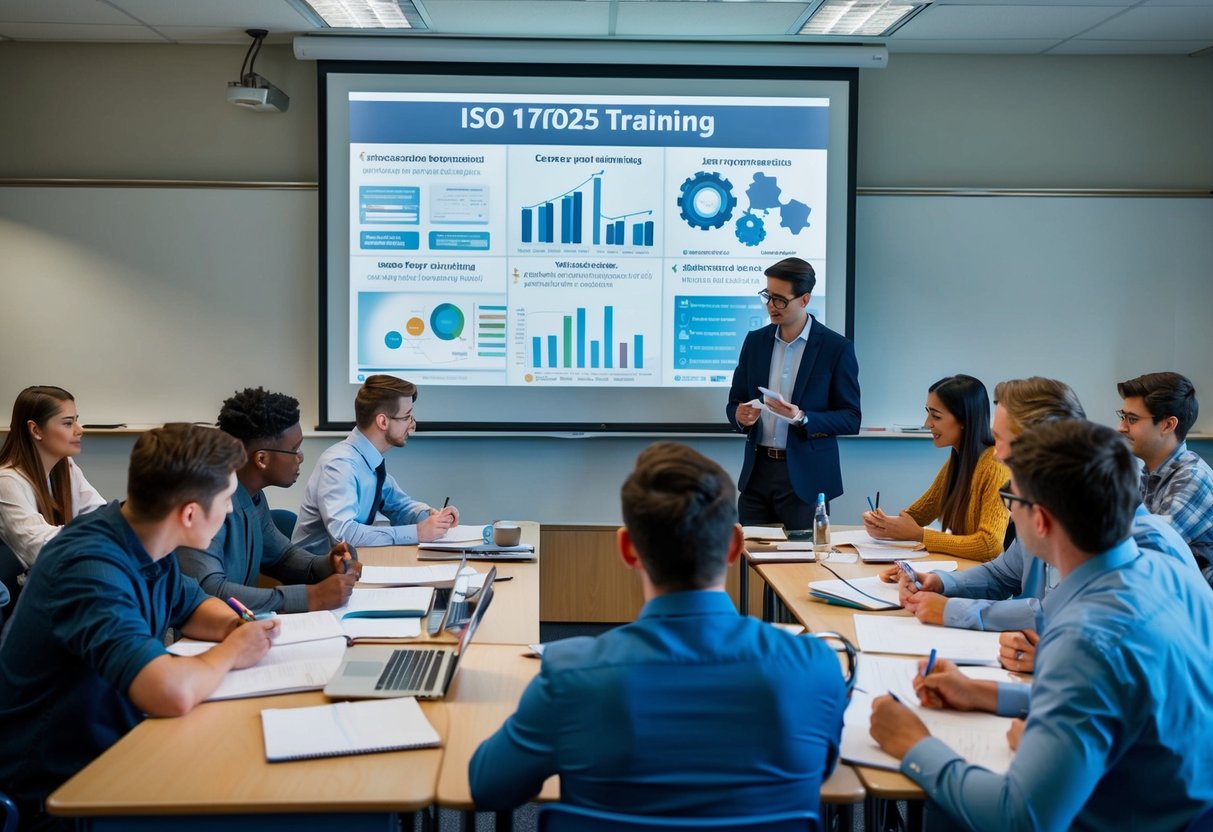
ISO 17025 training helps you build strong quality management systems for your lab. You’ll learn key strategies to implement reliable processes, ensure consistency, and drive ongoing improvements.
ISO 17025 Implementation Strategies
Start by mapping out your lab’s processes and identifying areas for improvement. Create clear policies and procedures that align with ISO 17025 requirements. Then, train your staff on new protocols and quality objectives.
Use a phased approach:
- Gap analysis
- Documentation development
- Staff training
- Internal audits
- Management review
Assign responsibilities and set deadlines for each phase. Then, track progress regularly. Consider using project management software to keep implementation on schedule.
Ensuring Consistency and Reliability
Standardize your lab’s methods and processes. Create detailed work instructions for all testing procedures. Then, implement rigorous document control to ensure staff always use the latest versions.
Key elements: • Equipment calibration program • Measurement traceability • Proficiency testing • Quality control checks
Use statistical tools to monitor method performance. Address any out-of-spec results promptly. Then, conduct regular internal audits to catch and fix issues early.
Continual Improvement Processes
Make quality improvement an ongoing focus. Encourage staff to suggest process enhancements. Then, use corrective and preventive action (CAPA) systems to address problems systematically.
Improvement tools:
- Root cause analysis
- 5 Whys technique
- Fishbone diagrams
Set measurable quality objectives. Review them regularly in management meetings. Then, use customer feedback and complaints to drive improvements. Stay up-to-date on industry best practices and emerging technologies in your field.
Advanced ISO 17025 Auditing Techniques

ISO 17025 auditing requires specialized skills to assess laboratory competence effectively. These techniques help auditors plan, conduct, and report on audits with precision and impact.
Audit Planning and Execution
Start by creating a detailed audit plan. Set clear goals and scope for the audit. Then, review key documents like quality manuals and procedures beforehand. This prep work helps you focus on important areas during the audit.
Use risk-based thinking to prioritize audit areas. Look at past issues, critical processes, and potential weak spots. Then, make an audit checklist to guide your work, but stay flexible.
When on-site, use a mix of methods:
- Observe lab activities
- Interview staff at different levels
- Review records and data
- Test key processes
Ask open-ended questions to get more info. Listen carefully and take good notes. Then, look for both good practices and areas to improve.
Ensuring Effective Audits
Be thorough but fair in your approach. Stay objective and focus on facts, not opinions. Then, use your technical knowledge to dig deep into lab processes.
Sample audit techniques:
- Trace a sample through the whole testing process
- Check equipment calibration records
- Review staff training and competence records
- Examine how the lab handles customer complaints
Don’t just look for problems. Note good practices too. This gives a balanced view of the lab’s performance.
If you find issues, gather solid evidence. Take photos or copies of records if needed. And always respect confidentiality rules.
Audit Reporting and Follow-Up
Write a clear, factual audit report. List both strengths and areas for improvement. Then, be specific about any nonconformities found. Explain why they don’t meet ISO 17025 requirements.
In your report:
- Describe audit scope and methods used
- List main findings and evidence
- Suggest actions to fix problems
- Highlight good practices seen
Hold a closing meeting with lab management. Go over key findings and answer questions. Then, agree on timelines for fixing issues.
Follow up later to check if problems were fixed. This helps ensure the audit leads to real improvements in lab quality.
ISO 17025 Accreditation Process and Maintenance

Getting ISO 17025 accreditation takes time and effort. You’ll need to meet specific criteria and follow set procedures. Once accredited, you must keep up with ongoing activities to maintain your status.
Accreditation Criteria and Procedures
To gain ISO 17025 accreditation, you must prove your lab’s competence. This involves a detailed review of your quality management system. You’ll need to show:
• Technical competence of staff • Proper equipment calibration • Sound testing methods • Valid results
The process starts with an application to an accrediting body like ANAB or ILAC. They’ll do a document review and on-site assessment. You may need to fix any issues they find. Once you meet all requirements, you’ll receive accreditation.
Post-Accreditation Activities
After getting accredited, your work isn’t done. You must:
• Take part in proficiency testing • Do internal audits • Review your management system yearly • Keep up with any ISO 17025 changes
Accrediting bodies will check on you regularly. They may do surprise visits or ask for updates. You’ll go through a full reassessment every few years.
You should always be ready for method witnessing. This is when an assessor watches you perform tests. It helps prove you’re still following proper procedures.
Specialized ISO/IEC 17025 Topics
ISO/IEC 17025 training covers both technical and non-technical areas. You’ll learn about managing complex lab processes and dealing with organizational challenges.
Handling Technical Aspects
You’ll dive into measurement uncertainty in ISO 17025 courses. This helps you grasp how to calculate and report uncertainties in test results.
Training on method validation is key. You’ll learn to prove your lab methods work as intended.
Courses also cover equipment calibration and maintenance. You’ll discover how to keep your tools accurate and reliable.
Proficiency testing is another focus. You’ll find out how to check your lab’s performance against others.
Addressing Non-Technical Challenges
Impartiality is a big topic in ISO 17025 training. You’ll explore ways to keep your lab fair and unbiased.
You’ll also learn about document control. This helps you manage lab records and keep them up-to-date.
Courses teach you how to handle customer complaints too. You’ll gain skills to solve issues and keep clients happy.
Training covers internal audits as well. You’ll find out how to check your lab’s work and spot areas for improvement.
Preparing for Lead Auditor Roles
Lead auditor training builds key skills for conducting ISO 17025 audits. You’ll learn audit planning, leadership, and reporting techniques. This helps you assess labs effectively.
Audit Leadership Fundamentals
Lead auditors guide audit teams and oversee the entire process. You need strong communication and people skills. So, practice giving clear directions and managing time well.
Learn to handle conflicts and tough situations calmly. Good leaders stay objective and professional. They listen to all views before making decisions.
Focus on the big picture while paying attention to details. You’ll need to juggle many tasks at once. So, work on your organization and multitasking abilities.
Developing Auditing Competence
To become a skilled auditor, study ISO 17025 requirements closely. Know the standard inside and out. Then, practice applying it to real lab situations.
Learn about different types of evidence and how to gather it. Get comfortable interviewing staff and reviewing documents. Then, develop a sharp eye for spotting issues.
Work on your report writing skills too. You must explain findings clearly and back them up with facts. Use simple language that non-experts can understand.
Take part in mock audits to gain hands-on experience. This helps you build confidence and learn from mistakes in a low-pressure setting.
Continuous Professional Development
ISO 17025 training courses offer ongoing opportunities to enhance your skills and stay current with industry standards. E-learning platforms and proficiency testing programs provide flexible ways to keep your knowledge sharp and your lab practices up-to-date.
Enhancing Skills with E-Learning
E-learning modules let you access ISO 17025 training anytime, anywhere. These online courses cover topics like document control, internal auditing, and measurement uncertainty. You can learn at your own pace through video lessons, quizzes, and practice exercises.
Many e-learning platforms offer:
- Interactive simulations of lab procedures
- Discussion forums to connect with other professionals
- Downloadable resources and templates
- Progress tracking and certificates
E-learning keeps your skills fresh without disrupting your work schedule. It’s a cost-effective way to train your whole team on ISO 17025 requirements and best practices.
Participating in Proficiency Testing
Proficiency testing (PT) helps you assess your lab’s performance against others. You’ll receive samples to analyze using your normal methods. Your results are then compared to those from other labs.
PT programs offer:
- Objective feedback on your testing abilities
- Identification of areas for improvement
- Compliance with accreditation requirements
Regular PT participation builds confidence in your results. It also helps you spot potential issues in your processes. You can use PT outcomes to fine-tune your procedures and training programs.
Frequently Asked Questions
ISO 17025 training courses offer many options for professionals seeking certification. Programs vary in length, cost, and delivery method. Let’s look at some common questions about these courses.
What is the best ISO 17025 online training course for small laboratories?
Answer
For most small laboratories, the best ISO 17025 online training course is one that doesn’t just explain the clauses, but walks you step-by-step through implementation. That’s exactly how I designed my ISO/IEC 17025 Implementation Masterclass. It’s a self-paced online course that combines video lessons with a complete set of ISO 17025 templates (quality manual, procedures, forms, and checklists), so you’re learning the standard while actually building your system.
I created the Masterclass based on my experience as a certified ISO/IEC 17025 assessor, focusing on what assessors actually look for in documents, records, and day-to-day practice. If you already have a basic understanding of ISO 17025 and just need a quick overview, a shorter online course may be enough. But if your goal is to get your lab accredited with limited time and staff, the Masterclass gives you a structured roadmap and done-for-you documentation instead of starting from a blank page.
How can one become ISO 17025 certified?
To get ISO 17025 certified, you need to take an accredited course. These courses teach the standard’s requirements and how to apply them.
After finishing the course, you must pass an exam. Some programs offer a certificate upon completion.
What is the duration of ISO 17025 training programs?
ISO 17025 training programs can last from a few days to several weeks. Short courses often cover basics in 2-3 days.
More in-depth programs may run for 1-2 weeks. Online courses let you learn at your own pace over several weeks or months.
What are the costs associated with obtaining ISO 17025 certification?
Costs for ISO 17025 certification vary widely. Factors include course length, format, and provider.
Short courses may cost a few hundred dollars. Longer, more comprehensive programs can cost several thousand. Online options are often cheaper than in-person classes.
What does ISO 17025 training entail?
ISO 17025 training covers the standard’s requirements for testing and calibration labs. You’ll learn about quality management systems and technical competence.
Courses often include practical exercises and case studies. Topics may cover document control, internal audits, and measurement uncertainty.
Are there any ISO 17025 training courses available online with certification?
Yes, many providers offer online ISO 17025 training courses with certification. These courses let you learn from home or work at your own pace.
Online programs often include video lessons, quizzes, and a final exam. Upon passing, you receive a certificate of completion.
What resources are available for ISO 17025 training, such as PDFs or PPTs?
Many ISO 17025 training providers offer additional resources. These may include PDFs of course materials and PowerPoint presentations.
Some organizations provide free guides and checklists online. You can also find ISO 17025 standards documents for purchase from official sources.
🕒 Book Your Free 45-Minute Consultation
Have questions about ISO/IEC 17025 or ISO 9001 implementation or accreditation? Schedule a free 45-minute consultation with me to discuss your Company or laboratory’s needs and how we can achieve compliance together.
Schedule Your Consultation