ISO 17025 Scope of Accreditation: Defining and Maintaining It
Defining the ISO 17025 scope of accreditation can feel complex, but it’s the foundation of your laboratory’s credibility. It shows exactly what tests or calibrations you’re accredited to perform and proves your technical competence. Your scope of accreditation clearly defines where your lab’s authority begins and ends, helping both customers and assessors trust your results.

A well-structured scope not only meets accreditation requirements but also helps manage expectations, streamline communication and account for overall ISO 17025 accreditation cost. When built effectively, it becomes a tool that supports consistency, accuracy, and confidence in your work. Keeping it up to date ensures your lab continues to meet evolving standards and client needs.
Understanding how to define, structure, and maintain your scope gives you more than compliance—it gives you control. You’ll know how to align your technical capabilities with accreditation standards and present your lab in a clear, professional way that builds trust and recognition.
Your scope of accreditation should follow internationally accepted practices for how activities, ranges, and uncertainties are described. ILAC provides detailed guidance for accreditation bodies and laboratories in its guidance on scopes of accreditation
.
Key Takeaways
- The scope of accreditation defines your lab’s accredited activities and boundaries.
- Clear structure and maintenance ensure continued compliance and consistency.
- Using your scope strategically strengthens quality, communication, and credibility.
ISO 17025 Scope of Accreditation Explained (Video Walkthrough)
If you prefer to learn visually, this video walks you step by step through the ISO 17025 scope of accreditation. I’ll show you how to read and structure a scope, highlight the key elements accreditation bodies look for, and walk through real examples for both testing and calibration laboratories.
In the video, I also share a sample heavy metals testing scope entry (using EPA 200.8) and a temperature calibration scope example for digital thermometers, so you can see how methods, ranges, and capabilities are actually documented in practice. Watch this first for an overview, then use the detailed guide below as a reference while you develop or refine your own scope of accreditation.
What Is the ISO 17025 Scope of Accreditation?
The ISO/IEC 17025 scope of accreditation defines the specific testing, calibration, or sampling activities your laboratory is authorized to perform under ISO 17025 accreditation. It outlines the exact methods, equipment, and measurement ranges included in your accredited services.
By clearly stating the scope, you show that your laboratory operates competently and produces valid results within defined boundaries. This helps customers, regulators, and other stakeholders understand what your lab is qualified to do.
A well-written scope usually includes:
- Laboratory identification: name, address, and accreditation reference
- Type of activity: testing, calibration, or sampling
- Discipline or field: chemical, biological, mechanical, electrical, etc.
- Test or calibration methods: including standards or internal procedures used
- Measurement range or uncertainty: limits within which your lab is accredited
| Component | Description |
|---|---|
| Activity Type | Specifies whether the lab performs testing, calibration, or both |
| Methods Used | Lists recognized standards or validated methods applied |
| Measurement Limits | Defines the scope or range of capability |
| Accreditation Details | Connects each activity to the applicable accreditation body record |
Defining your scope is not only a requirement but also a tool for transparency. It ensures that you, as a laboratory, communicate your technical competence clearly and maintain consistency with ISO/IEC 17025 requirements.
Key Elements of a Scope of Accreditation

A scope of accreditation defines exactly what your laboratory is qualified to perform and under what conditions. It outlines the types of tests or calibrations, measurement capabilities, and accepted methods, ensuring clear communication with clients, auditors, and accreditation bodies. Each element supports transparency, consistency, and technical credibility.
Tests or Calibrations Performed
You must clearly list every test or calibration that your laboratory performs under accreditation. Each listed activity should reflect demonstrated technical competence, validated through proficiency testing, staff qualifications, and equipment suitability.
Use consistent terminology that matches your standard operating procedures (SOPs) and technical records. Avoid vague or overly broad descriptions; they weaken confidence in your claimed capabilities. For example, instead of “chemical analysis,” specify “analysis of lead content in drinking water by atomic absorption spectroscopy.”
Including well-defined tests or calibrations helps establish impartiality by limiting activities to areas where you can show competence. It also assists assessors in verifying compliance with the appropriate technical and management requirements of ISO/IEC 17025.
Measurement Ranges and Units
Define the measurement ranges and units for each activity listed in your scope. These values describe the limits of your laboratory’s reliable operation. For example, a calibration lab might report a range of 0.1 °C to 500 °C, while a mechanical testing lab might specify tensile forces from 1 N to 100 kN.
Always express ranges using internationally recognized SI units or other accepted standards. This enables clients and regulators to interpret results without confusion.
Document the methods used to validate each range. Data from equipment verification, control charts, and reference material checks can be used to confirm that your instruments remain accurate and stable across the full range.
Methods or Standards Used
List each method or standard followed for accredited testing or calibration work. Accepted references may include ISO, ASTM, IEC, or national standards. Where you use in-house methods, describe their validation process to prove they produce technically valid results.
You should keep detailed SOPs for every method in use, including the version number and revision date. This maintains data integrity by linking your results to specific, traceable procedures.
Your staff must be trained in these methods and demonstrate consistent application. Using verified and standardized methods ensures the comparability of results across laboratories and supports your lab’s credibility with customers and auditors.
Measurement Uncertainty / Decision Rules (Where Applicable)
When applicable, include measurement uncertainty for your tests or calibrations. This shows the degree of confidence you have in reported values. ISO/IEC 17025 requires you to identify all significant sources of variation—instrument precision, operator influence, environmental factors—and combine them to estimate uncertainty.
For decision rules, describe how you interpret measurement results in relation to tolerance limits or specifications. For example, you might use a rule based on guard bands to reduce the risk of false acceptance.
Clear reporting of uncertainty and decision rules enhances transparency and helps clients understand the reliability of your measurements. It also demonstrates sound technical judgment and a structured approach to quality assurance.
Locations and On-Site / Field Activities
If you conduct accredited work at multiple locations or in the field, specify these areas in your scope. Identify fixed facilities, mobile units, and any on-site testing where your procedures apply. This supports organizational structure clarity and ensures that all relevant management and ISO 17025 technical requirements are met.
Each site should maintain consistent calibration control, documentation practices, and adherence to approved SOPs. When performing field activities, ensure your equipment is properly calibrated and that environmental conditions are suitable for reliable results.
Listing on-site and field activities also helps maintain impartiality, as it shows clients where accredited work occurs and under what controls. It ensures every result aligns with the same standards of competence and quality found within your main laboratory.
Fixed vs Flexible Scope of Accreditation

A laboratory’s scope of accreditation defines which tests and methods are officially recognized as competent and compliant with ISO/IEC 17025. Whether the scope is fixed or flexible affects how you manage change, respond to client needs, and maintain compliance records. Understanding these two types helps you choose the right structure for your lab’s operations and growth.
What a Fixed Scope Looks Like
A fixed scope of accreditation lists all specific tests, methods, and materials your lab is accredited to perform. Each item is reviewed and approved by the accreditation body. You cannot add, remove, or change any test listed without prior authorization.
This approach provides tight control and consistency. Regulators and customers can easily see your exact capabilities. It works best when your test methods rarely change or when external approvals are required for each variation.
However, a fixed scope can create delays. For example, if you need to add a new analyte or adjust a method, you must submit an application for a scope expansion. That process may take weeks, especially if the accreditation body needs to observe the method before approval.
Typical fixed scope content includes:
| Element | Description |
|---|---|
| Test name or parameter | Exactly what is measured |
| Test method | Standard or internal method version |
| Material/product type | Type of sample tested |
| Range or limit | Defined measurement range |
What a Flexible Scope Allows
A flexible scope of accreditation gives you controlled authority to make certain changes without prior evaluation by your accreditation body. You may modify parameters such as test range, matrix, or analytes, as long as the changes fall within your demonstrated competence.
Your lab must show that it has documented procedures for method validation, verification, and control of changes. This includes clear records and defined boundaries for what flexibility covers. For instance, you might add a new metal to an existing water analysis method if it uses the same analytical process.
A flexible scope offers faster adaptation to new client demands or emerging issues—such as testing for contaminants during a food safety event—while maintaining traceability under ISO/IEC 17025. Still, it requires additional oversight and documentation to prove you manage that flexibility responsibly.
Common areas of flexibility may include:
- Addition of analytes or components within a tested matrix
- Adjustments to reporting range or method version
- Replacement of equivalent instruments or reagents
Which Approach Fits Your Lab
The right choice depends on your lab’s testing environment, workload, and risk tolerance. If your testing portfolio is well established and stable, a fixed scope offers reliability and clear boundaries. It minimizes uncertainty about compliance and is easier to maintain for smaller operations.
If your lab serves sectors that face frequent updates—such as environmental monitoring, food testing, or materials analysis—a flexible scope could offer the agility you need. It helps you stay competitive by shortening approval times for new or modified tests.
Before requesting flexibility, evaluate whether your management system can handle it. You will need strong internal review, training, and risk assessment processes to ensure every change meets ISO/IEC 17025 requirements.
Step-by-Step: Defining Your Initial Scope
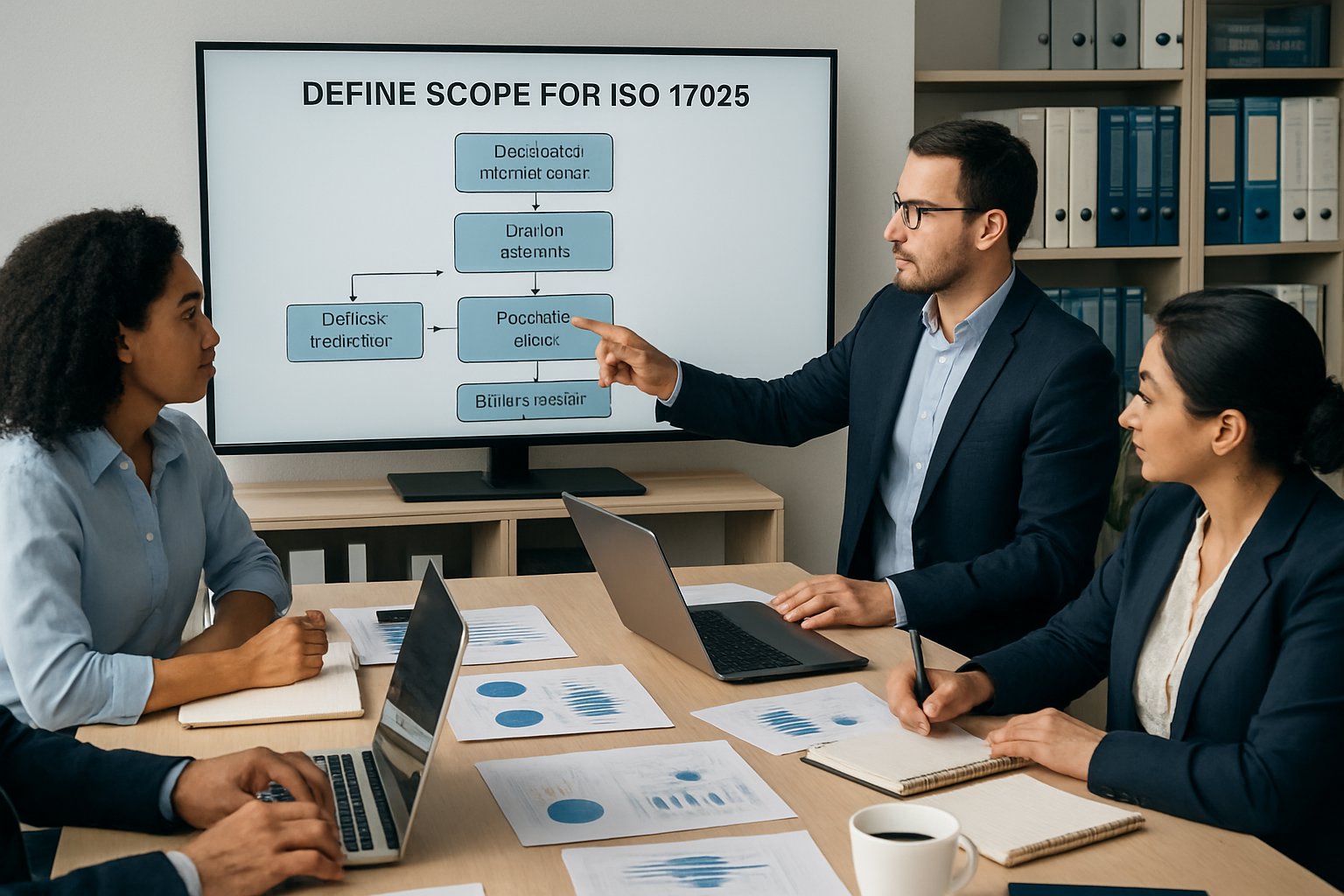
A clear scope of accreditation matches your testing or calibration work to recognized standards and proven competence. It depends on what your lab can perform reliably, what your customers need, and what your system can support with validated methods, traceability, and trained staff.
Start From Customer and Regulatory Needs
Define your scope based on what your customers and regulators actually require from your lab. Identify the types of tests or calibrations, the measurement ranges, and the tolerances your clients request most often. Then check if any industry standards, legal limits, or contractual requirements apply.
Create a short list of critical items:
- Products, materials, or instruments to be tested or calibrated
- Required accuracy or uncertainty levels
- Turnaround time and reporting format
This list helps you avoid building a scope that includes unnecessary or unsupported work. Be realistic about what you can currently demonstrate competence in. If a regulator expects compliance with specific test methods, reference those exact method numbers.
Use customer inquiries and past job records to identify the tests that drive your workload. This ensures your scope reflects real demand instead of guesswork.
Map Existing Methods, Equipment, and Competence
Next, align your current technical capability with potential scope items. Review your test and calibration methods, equipment calibration status, and personnel competency records. Confirm that each method is validated or verified for your intended use. If not, plan and document the validation activities.
Make a table to visualize coverage:
| Capability Area | Method/Procedure | Equipment | Personnel Qualified | Validation Status |
|---|---|---|---|---|
| Temperature | ASTM E2877 | Digital Thermometer | J. Smith | Validated |
| Pressure | ISO 6789 | Pressure Gauge Set | L. Chang | Verification Pending |
This cross-reference shows where you already meet ISO/IEC 17025 requirements and where to improve. Any method listed in the draft scope must be supported by appropriate equipment calibration and training records. Keep evidence such as certificates, method validation reports, and competency reviews ready for auditor verification.
Decide What to Include Now vs Later
When developing your first scope, balance completeness with feasibility. Not every future service should appear in the initial submission. Include only those activities that you can fully support with validated methods, calibrated equipment, and competent personnel.
Ask yourself:
- Do you have complete method validation data for each parameter?
- Are calibration and measurement uncertainty properly established?
- Can you show at least one trained, competent staff member per method?
If any answer is no, mark those activities for a future scope expansion. Most accreditation bodies allow you to add new capabilities after the initial assessment once proof of competence is available. Document your long-term plan internally, but only include present, verifiable capabilities in the accredited scope.
Check PT and Traceability Support
Each scope item must be backed by suitable ISO 17025 proficiency testing (PT) or interlaboratory comparison programs and traceable calibration references. Verify that you can access PT schemes relevant to your measurement areas. Participation provides external confirmation of competence, often required by ISO/IEC 17025.
For traceability, ensure that all reference standards used for calibration link to national or international standards through unbroken chains of accredited calibration. Keep traceability records such as certificates, calibration intervals, and uncertainty budgets.
Create a simple traceability map showing each measurement parameter, its reference source, and associated PT provider. This documentation helps you demonstrate that results in your proposed scope are both technically valid and traceable, giving confidence to accreditation assessors and customers alike.
Examples of Scope Structures
A well-structured scope of accreditation clearly lists each accredited activity, associated measurement or test range, and the uncertainty or method used. It organizes technical information in a way that helps auditors, customers, and staff easily understand your laboratory’s capabilities and limitations.
Example – Calibration Laboratory
In a calibration laboratory, the scope usually appears in a tabular format that lists each measurement parameter, range, and Calibration and Measurement Capability (CMC) uncertainty. Each entry includes the relevant instrument type, method, and standard used. This structure allows readers to compare your measurement capability to other calibration laboratories.
For example, a table might include these columns:
| Measurement Parameter | Range | CMC Uncertainty | Reference Standard | Method/Procedure |
|---|---|---|---|---|
| Temperature | -80 °C to 500 °C | ±0.3 °C | SPRT, Dry Block | SOP-TEMP-01 |
| DC Voltage | 0 V to 1000 V | ±(2.0 × 10⁻⁶ V) | Calibrator Model XYZ | SOP-VOLT-02 |
Your scope should only include accredited activities verified during assessment. Maintain alignment between the published scope and your calibration records so results remain traceable and defensible. When you add new parameters, contact your accreditation body before performing work under accreditation.
Example – Testing Laboratory
A testing laboratory’s scope typically lists test types, materials, and methods rather than measurement ranges. The format often uses a structured list or table to show each test and the applicable standard method, such as ASTM, ISO, or internal procedures approved during assessment.
| Test Type | Material/Test Item | Method or Standard |
|---|---|---|
| Tensile Strength | Metal Alloys | ASTM E8/E8M |
| pH Measurement | Water Samples | ISO 10523 |
Keep entries concise but accurate. Each description should match the terminology found in your procedures and reports. Test scopes rarely specify uncertainty values, so clarity in the method and specimen type is essential. Use consistent units and standardized references to ensure that clients and regulators can interpret your scope without confusion.
Common Scope Mistakes (and How to Avoid Them)
A laboratory’s scope of accreditation defines its technical boundaries and directly affects audit results, customer trust, and compliance with ISO/IEC 17025. Mistakes in drafting or maintaining the scope often cause non-conformities, unclear responsibilities, and delays in accreditation. Accurate documentation, controlled revisions, and consistent internal audit reviews help you avoid these issues.
Scope Too Broad for Your Real Capability
A scope that covers tests or calibrations your lab cannot consistently perform leads to serious credibility problems. If your capabilities do not match the scope, auditors will flag non-conformities under competence and structural requirements. This can cause follow‑up corrective actions and even suspension of accreditation.
Broad claims often appear when a lab uses template scopes or copies text from another organization. Each parameter, method, and range must reflect what your lab actually does using available equipment, qualified staff, and validated methods.
During internal audits, check that your records—such as quality manuals, method validations, and proficiency test results—support each item in your scope. Document control should ensure that updates to test methods or equipment changes trigger a review of the scope. Keeping your scope narrow but accurate improves audit outcomes and customer confidence.
| Key Check | Action |
|---|---|
| Method listed but not in use | Remove or update method reference |
| Equipment retired or replaced | Revise scope and quality records |
| Staff no longer competent | Adjust authorization matrix |
Scope Too Vague or Generic
Vague scope statements cause confusion for auditors and clients. Phrases like “chemical testing” or “mechanical calibration” without details on measurement ranges, standards used, or sample types lack the specificity required by ISO/IEC 17025.
You should list exact parameters and include measurable information such as the method name and identification, limit of detection, or calibration range. The quality manual and supporting documentation should clarify how the lab performs each activity.
A clear scope ensures traceability between scope entries, test methods, and laboratory practices. When you use consistent terminology across your internal documents, audit findings are easier to resolve, and nonconforming work is less likely to occur. Review your published scope during management review meetings to confirm it aligns with actual operations and current standards.
Scope and Internal Documents Don’t Match
Your scope, method procedures, and supporting documentation must tell the same story. If the scope includes a method not described in your ISO 17025 quality manual or referenced incorrectly in work instructions, auditors will likely record a non‑conformity.
This mismatch also shows weak document control. Each time you introduce new equipment or update a method, you should cross‑check related documents—procedures, forms, and calibration records. Inconsistent references create gaps that make internal and external audits harder.
To prevent such errors:
- Maintain a controlled list of all active methods and equipment.
- Perform internal audits specifically targeting alignment between the scope and quality records.
- Record any discrepancies and assign corrective actions with defined responsibilities and deadlines.
Keeping supporting evidence consistent across all documents demonstrates that your management system is reliable and well maintained.
Forgetting Field Work or Subcontracted Activities
Many labs overlook off‑site and subcontracted testing or calibration. If you perform sampling or testing in the field but fail to include or describe these activities in your scope, your accreditation does not cover them. This often leads to non-conforming work and additional audits.
Your structural requirements require that you identify all activities under your management system’s control. This includes subcontractors that perform part of a test or calibration on your behalf. You must define how you evaluate and approve these providers, maintain quality records of their performance, and ensure results meet ISO/IEC 17025 criteria.
Document each location where testing occurs and specify which parts of the work are subcontracted. Internal audits should verify that fieldwork and subcontracting processes appear in your quality manual, contract reviews, and scope. Doing this keeps your accreditation valid and prevents misunderstandings with clients or assessors.
Keeping Your Scope of Accreditation Up to Date
Keeping your scope current ensures that your testing or calibration work remains aligned with your laboratory’s actual competence and complies with ISO/IEC 17025 requirements. Maintaining accuracy protects your accreditation status, supports quality management, and builds customer trust through consistent communication and verified data.
Change Control for Methods, Equipment, and Ranges
You need a structured change control process to manage updates to test methods, equipment, or measurement ranges. Each modification should be documented and evaluated for its impact on your quality management system (QMS) and scope of accreditation.
When you introduce a new method, validate and confirm that it meets ISO/IEC 17025 technical requirements. For equipment changes, verify calibration status, environmental conditions, and operator competency before adding it to accredited activities. Adjusting measurement ranges also requires demonstrating capability and uncertainty calculations through supporting records.
A clear review procedure helps prevent nonconformities during internal audits and external assessments. You can organize changes using a simple table for traceability:
| Change Type | Description | Evaluation Date | Approved By | Impact on Scope |
|---|---|---|---|---|
| Method | New ASTM-based tensile test | 2025-05-10 | QMS Manager | Add to scope |
| Equipment | Replacement of pressure gauge | 2025-06-15 | Technical Lead | Range adjusted |
Keeping strong documentation practices ensures consistency and readiness for surveillance visits.
Communicating Changes With Your Accreditation Body
Your accrediting body expects prompt notification of any adjustments that affect your accredited activities. Communication should occur before implementing major changes to avoid compliance gaps or audit findings.
Establish a formal channel, such as a controlled form within your QMS, for requesting scope revisions. Provide objective evidence of competence, including method verification data, updated uncertainty budgets, and relevant training records.
During reassessments or surveillance audits, be prepared to explain the changes and show supporting documentation. Quick, transparent updates reflect a mature management system and strong quality control culture. Maintaining open communication can also reduce delays when expanding your scope or renewing accreditation.
Regularly review correspondence logs and approval letters to confirm that all updates are recognized by the accreditation body and accurately reflected in public listings.
Using Risk-Based Thinking
Applying risk-based thinking helps you evaluate how changes to the scope might influence the reliability of your results and the integrity of your management system. Consider both the likelihood and consequence of each change.
For example, adopting a new measurement technique poses risks related to training adequacy, data accuracy, and compatibility with existing methods. Document identified risks and determine control actions, such as additional verification, calibration cross-checks, or method comparisons.
Integrate risk activities into your continuous improvement and quality management processes. Review risk outcomes during management reviews to decide if further controls or revisions are necessary.
By tying risk evaluation to change control, you reinforce proactive decision-making and compliance with ISO/IEC 17025 expectations. This approach improves audit readiness and supports long-term consistency in accredited performance.
Using Your Scope as a Management and Marketing Tool
Your scope of accreditation does more than satisfy ISO/IEC 17025 requirements. When managed properly, it helps train staff, improve customer communication, and support management reviews that strengthen accountability and drive operational excellence.
Training Staff With the Scope
Your scope acts as a clear reference for what your laboratory is accredited to do. Use it when onboarding new staff so they understand which activities, instruments, and test methods are covered under accreditation. This builds confidence in their daily work and reduces mistakes caused by unclear boundaries.
Hold short review sessions with technical personnel and supervisors. Discuss each section of the scope in plain language and link it to real tasks. For example, show how measurement ranges or CMC (Calibration and Measurement Capability) limits apply to your equipment.
A concise version of your scope can also serve as a training checklist:
| Training Element | Purpose | Responsible Person |
|---|---|---|
| Accredited test or calibration method | Define scope limit | Laboratory manager |
| Uncertainty statement | Reinforce technical understanding | Technical staff |
| Equipment list | Verify availability and status | Quality manager |
By integrating the scope into staff performance discussions, you maintain accountability and ensure that personnel stay aligned with current accreditation boundaries.
Helping Customers Understand Your Services
Your scope is often the first document clients see when deciding if your laboratory meets their needs. A clear and well-structured scope allows customers to identify which tests, materials, or measurement ranges you cover without having to call for clarification.
Use consistent terminology that matches customer language. Adding brief explanatory notes or tables can make it easier to read without breaching ISO formatting rules. Highlight important elements like measurement capabilities, testing methods, and uncertainty statements so potential clients can judge fit and competence quickly.
Your sales and customer service teams should understand how to use the scope as a marketing reference. When clients request quotes, attach the relevant scope section to demonstrate accredited capability. This approach reduces miscommunication and strengthens trust in your laboratory’s professionalism.
Feeding Management Review and Strategy
A well-maintained scope provides measurable input for management reviews. Changes in accreditation status, withdrawn methods, or new measurement functions reveal how effectively your laboratory adapts to customer needs and technical developments.
During review meetings, analyze scope data such as the number of accredited parameters or how often certain capabilities are used. This helps assess resource allocation, identify training gaps, and set priorities for equipment purchase or method development.
The laboratory manager can use scope updates as performance indicators for operational excellence. For example, adding a new test method may reflect successful staff development, while frequent corrections may indicate weak document control.
By linking your scope to strategic objectives, you promote accountability and maintain a practical connection between daily operations and long-term accreditation goals.
Next Steps – Review and Improve Your Scope
You should evaluate how well your scope describes your laboratory’s accredited work and whether it answers key customer and auditor questions. Focus on accuracy, clarity, and consistency to avoid misunderstandings and missing capabilities. Use a structured review approach to find weak areas and take action before your next audit or reassessment.
Compare Your Current or Draft Scope to This Checklist
Review your current or draft scope against a clear list of requirements. Use the checklist below to confirm that each section meets ISO/IEC 17025 expectations and your accreditation body’s format:
| Area | Checkpoints |
|---|---|
| Content Accuracy | Are all accredited tests, calibrations, and ranges listed correctly? |
| Traceability | Are methods and standards cited properly? |
| Clarity | Can a customer understand your listed capabilities easily? |
| Measurement Uncertainty | Are uncertainties shown where required? |
| Currency | Are contact details and equipment lists still current? |
| Formatting | Does the layout follow your accreditation body’s template? |
Read the scopes of similar accredited laboratories to compare presentation and terminology. Notice how others describe measurement functions, limits, and CMC values. If you find gaps in your scope—such as missing methods or outdated uncertainty values—note them for update. Keep revision dates in a separate record so you can track what changed during each update.
Get Help if You’re Unsure
If you are uncertain how to phrase test methods or list measurement parameters, contact your accreditation body directly. Most provide templates, guidance documents, or examples of accepted scope formats. Each accreditation body—such as A2LA, ANAB, PJLA, NVLAP, or IAS—has small but important formatting and terminology differences.
You can also consult peers from other accredited laboratories. Reviewing scopes in your field helps you see how experienced labs describe similar capabilities. Some laboratories use quality consultants who specialize in ISO 17025 documentation. This can save time if you have complex or multi-discipline scopes.
Before final submission, validate your draft through an internal technical review. Ask qualified staff to check that parameters, methods, and units correctly reflect your lab’s actual work. Ensuring accuracy now prevents delays or findings during the assessment stage.
Frequently Asked Questions
You define your laboratory’s ISO 17025 scope of accreditation by identifying accredited activities, ensuring clear structure, and following the specific technical and management system requirements in the standard. Maintaining it requires regular reviews, proper documentation, and active control of changes to measurement capabilities and methods.
What are the essential elements for defining the scope of accreditation in ISO 17025?
You must include all tests or calibrations for which your laboratory seeks accreditation. The scope should specify measurement functions, ranges, units, methods, and uncertainties.
Each listed activity must reflect your actual technical competence and available equipment. You should also include details such as the laboratory name, location, and accreditation certificate number, which are required by accreditation bodies.
How do you structure the scope of accreditation according to ISO 17025 guidelines?
Organize the scope in a clear and standardized format provided by your accreditation body. Testing laboratories commonly list materials tested, types of tests, and methods used. Calibration laboratories usually list measurement functions, ranges, and Calibration and Measurement Capabilities (CMCs).
Include key identifiers and maintain consistent terminology that aligns with your accreditation body’s policies. This structure helps clients and assessors understand your capabilities quickly.
What are the maintenance requirements for a laboratory’s scope of accreditation under ISO 17025?
You must keep the scope current at all times. Update it whenever there are changes in equipment, methods, or personnel that affect accredited activities.
Conduct periodic internal reviews to verify that all activities remain within accredited limits. During reassessment or surveillance visits, ensure your documented scope matches your laboratory’s demonstrated capabilities.
Can you outline the structural requirements for compliance with ISO 17025?
The structure of the scope must clearly define the laboratory’s accredited testing and calibration capabilities. Each measurement parameter should include the associated method, range, and uncertainty.
Your documentation must also support traceability to recognized standards. This structure ensures consistency with both ISO 17025 and accreditation body criteria.
What is the process for updating a laboratory’s ISO 17025 scope of accreditation?
To make changes, you first prepare a draft updated scope using the accreditation body’s template. Submit the draft with evidence of competence, such as calibration data or method validation results.
After review, the accreditation body may require an assessment before approving the revised scope. Always wait for formal confirmation before advertising new or expanded capabilities as accredited.
How does ISO 17025 Clause 5 influence the scope of accreditation?
Clause 5 outlines technical requirements that directly affect your scope. It covers factors like personnel competence, equipment calibration, measurement traceability, and method validation.
Your scope must reflect compliance with these requirements. Any activity listed must meet the competence and control expectations defined in Clause 5 to ensure accurate, reliable testing or calibration results.
Conclusion
You strengthen your laboratory’s credibility when you define your ISO 17025 scope clearly and keep it up to date. A detailed scope shows which tests, calibrations, and standards apply to your operations. It also sets limits on what you can and cannot claim under accreditation.
Use the scope as a working reference tool rather than a static document. Review it regularly when equipment, staff, or methods change. Even small updates help ensure accuracy and compliance.
To manage it effectively, focus on three main practices:
- Document clearly: Use consistent terms and format.
- Verify competence: Match each listed activity with proven technical capability.
- Communicate openly: Share the current scope with clients and accreditation bodies.
A structured scope also supports efficient audits and reduces misunderstandings. It gives customers confidence in your technical work and helps them choose your services with full awareness of your capabilities.
Maintaining a precise, transparent, and current scope demonstrates your commitment to reliable results and continuous quality in testing and calibration.
🕒 Book Your Free 45-Minute Consultation
Have questions about ISO/IEC 17025 or ISO 9001 implementation or accreditation? Schedule a free 45-minute consultation with me to discuss your Company or laboratory’s needs and how we can achieve compliance together.
Schedule Your Consultation