
ISO 17025 Uncertainty Budget Example: Worked Calculation
If you are looking for an ISO 17025 uncertainty budget example you can copy and defend, this article builds one from start to finish. The case is a chemical testing lab that prepares a stock calibration standard from a certified reference material (CRM). The budget follows the GUM approach (JCGM 100), in the order an assessor checks it under ISO/IEC 17025 clause 7.6.
Every figure below is illustrative. The structure, the reasoning behind each input and the arithmetic carry over to your own lab, but the numbers must come from your balance certificate, your CRM certificate and your own data.
What an assessor expects to see in an uncertainty budget under clause 7.6
Clause 7.6.1 requires the lab to identify the contributions to measurement uncertainty and to take into account every contribution that is significant. Clause 7.6.3 requires testing laboratories to evaluate measurement uncertainty. Clause 6.5 adds that the inputs must be metrologically traceable, which is why the CRM and balance certificates matter as much as the arithmetic.
An assessor usually works through a budget in a fixed order, and the file should be organised to match:
- The measurand and its equation. What exactly is being measured or prepared, in what units, and how the result is calculated from the inputs.
- The list of sources. Which contributions were considered, which were included, and a written reason for each one left out.
- Evidence for every number. A certificate, a data set, a manufacturer’s specification or a documented judgement, with the reference to where it lives in the quality system.
- The combination. Sensitivity coefficients, the combined standard uncertainty, and the coverage factor with a stated reason for choosing it.
- The reported result. The expanded uncertainty, its coverage factor and confidence level, and sensible rounding.
An assessor can recompute a budget in a few minutes with a calculator. If the arithmetic reproduces your stated result and every input traces to a document, the budget is easy to accept. If an input has no source, that gap is what gets written up.
The example: a chemistry lab preparing a stock standard from a certified reference material
The lab needs a stock standard of a single organic analyte at about 1000 mg/L, which it dilutes into working calibration standards. The preparation is simple:
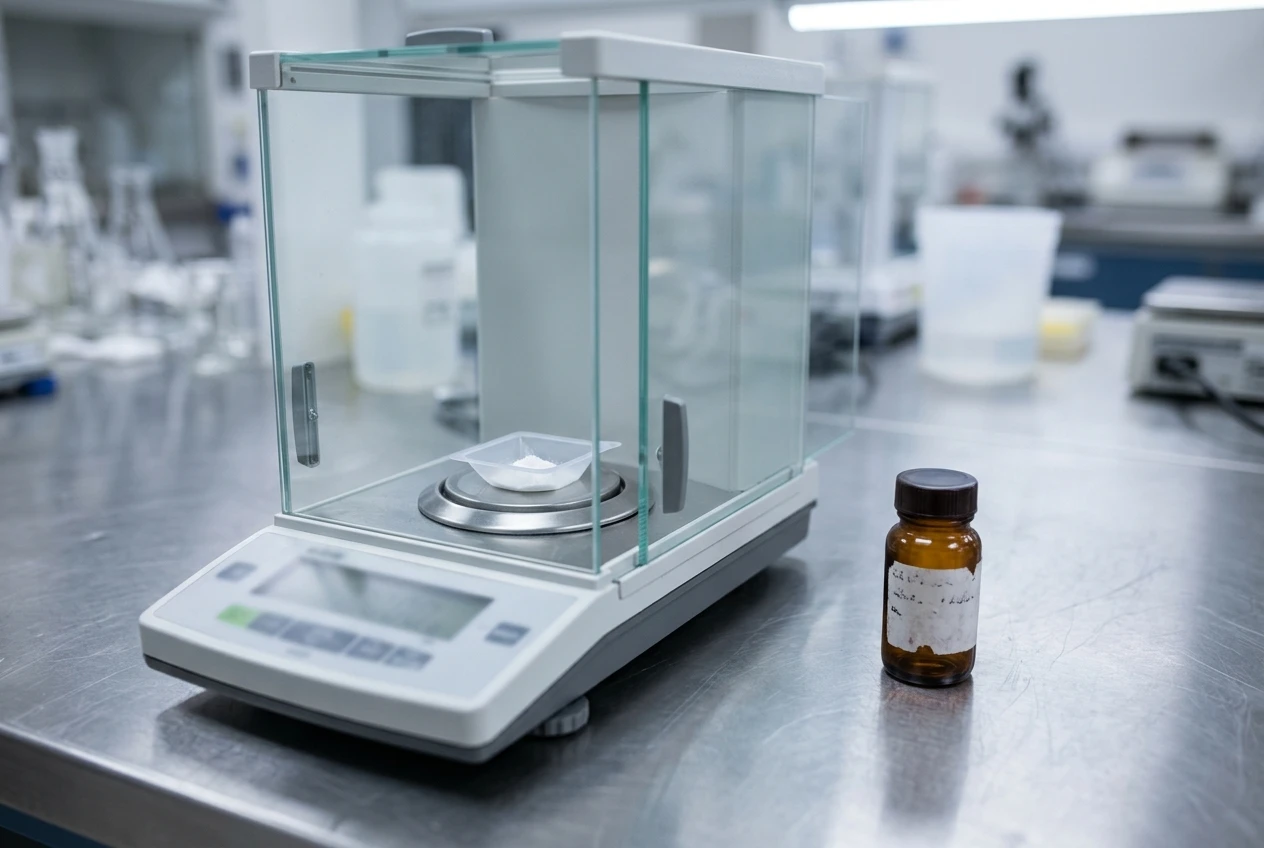
- The lab weighs about 100 mg of a neat solid CRM on an analytical balance.
- It transfers the solid to a 100 mL Class A volumetric flask, dissolves it, and makes up to the mark with an aqueous solvent.
- The CRM certificate gives a purity of 99.5 % with an expanded uncertainty of 0.2 % (k = 2).
- The balance has a readability of 0.01 mg and a calibration certificate stating an expanded uncertainty of 0.20 mg (k = 2) at this load.
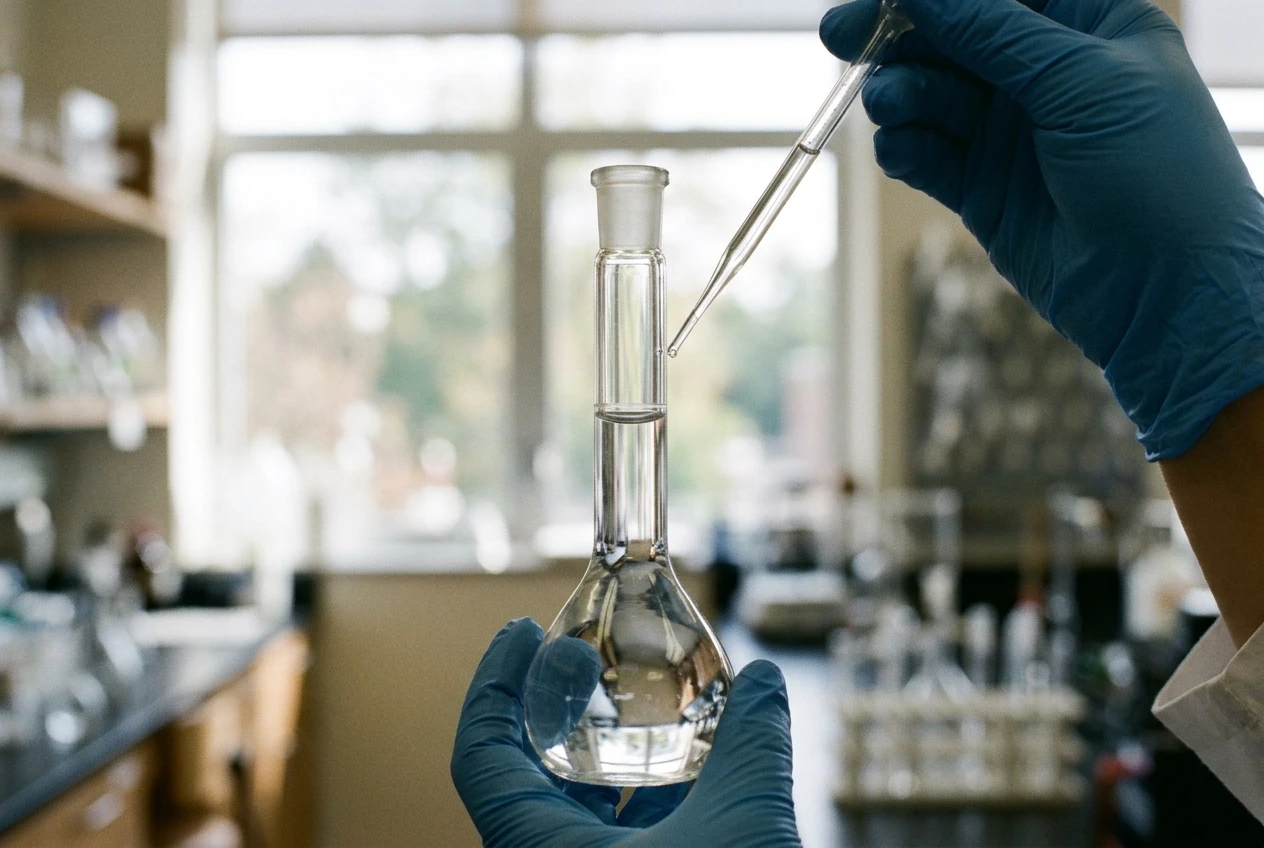
- The flask has a manufacturer tolerance of ±0.10 mL at 20 °C.
- Laboratory temperature is controlled to within ±3 °C of 20 °C.
This budget covers the preparation of the stock standard only. The uncertainty of the stock then becomes one input into the budget for the test method that uses it. That is the normal pattern: a small budget for each preparation step feeds the larger budget for the reported result.
Step 1: Define the measurand and write the measurement equation
The measurand is the mass concentration of the analyte in the stock solution, in mg/L. The equation follows directly from the preparation:
c = 1000 · m · P · F_T / V
- c is the concentration of the stock standard in mg/L.
- m is the mass of CRM weighed, in mg.
- P is the purity of the CRM as a mass fraction (0.995), dimensionless.
- F_T is a temperature correction factor on the volume, with a best estimate of 1 and an uncertainty that reflects how far the room temperature may drift from 20 °C.
- V is the volume of the flask in mL.
- 1000 converts mg/mL to mg/L.
With the illustrative values, c = 1000 × 100.00 × 0.995 × 1 / 100.0 = 995.0 mg/L.
Two points make this equation defensible. First, every symbol has a unit, so an assessor can see that the units resolve to mg/L. Second, F_T appears in the equation even though its value is 1. Writing an input into the model with a best estimate of 1 is the standard way to give a source with no correction an uncertainty and a sensitivity coefficient. Without it, the temperature contribution would appear in the table with nothing in the model to connect it.
Step 2: List every uncertainty source and decide which ones matter
Start with the full list, then decide. For this preparation the list is:
- CRM purity. Included. The certificate gives an uncertainty, and purity multiplies directly into the result.
- Balance calibration. Included. The certificate gives an uncertainty at the working load.
- Balance readability. Included. The balance shows a rounded value, and two readings (tare and gross) are taken for each weighing.
- Balance repeatability. Covered by the certificate. In this illustration the certificate’s stated uncertainty includes the repeatability observed during calibration. Check that yours does before relying on that.
- Air buoyancy. Judged negligible for this illustration. In a real budget, record the estimate that supports that judgement, because “negligible” with no number is a common finding.
- Flask volume tolerance. Included. It is a manufacturer’s limit with no further information on the distribution.
- Filling repeatability. Included. Judging the meniscus varies from fill to fill, and the lab has data on it.
- Temperature. Included. The solution expands or contracts with the room temperature.
- CRM homogeneity. Covered by the CRM certificate, provided the amount weighed is not below the minimum sample size the certificate states. Check that the 100 mg portion meets it.
- Incomplete dissolution. Excluded, controlled by the procedure, which requires a clear solution before making up to volume.
- Stability of the stock after preparation. Outside this budget. It is handled by a stability study that sets the expiry date, and the uncertainty of the standard at the time of preparation is a separate question.
The reasoning for each exclusion belongs in the file. A budget that shows eleven sources considered and five included reads as a competent evaluation. A budget that shows five sources and nothing else invites the question of what else was thought about.
Step 3: Quantify each input as a standard uncertainty (Type A and Type B)
The GUM separates two kinds of evaluation. Type A uses statistics on repeated observations. Type B uses everything else: certificates, specifications, published data and experience. Both end as a standard uncertainty, equivalent to one standard deviation, so that they can be combined.
Input | Type | Basis | Standard uncertainty |
|---|---|---|---|
m, balance calibration | B | Certificate U = 0.20 mg, k = 2 | 0.100 mg |
m, readability | B | Resolution 0.01 mg, rectangular, two readings | 0.0041 mg |
P, CRM purity | B | Certificate U = 0.2 %, k = 2 | 0.0010 |
V, flask tolerance | B | ±0.10 mL, rectangular | 0.0577 mL |
V, filling repeatability | A | s = 0.020 mL from 10 fills | 0.020 mL |
F_T, temperature | B | ±3 °C, rectangular | 0.000364 |
Balance calibration and readability
The certificate states an expanded uncertainty at k = 2, so the standard uncertainty is 0.20 / 2 = 0.10 mg. Using the expanded value directly is one of the most common arithmetic errors in budgets.
Readability has a half-width of 0.005 mg (half the 0.01 mg resolution). With a rectangular distribution, u = 0.005 / √3 = 0.00289 mg per reading. A weighing involves two readings, so u = √2 × 0.00289 = 0.0041 mg. The two balance terms combine to √(0.100² + 0.0041²) = 0.1001 mg. Readability barely changes the total here, but it matters on smaller weighings, and it shows the assessor it was considered.
CRM purity
The certificate gives 99.5 % ± 0.2 % at k = 2. As a mass fraction, P = 0.995 and U = 0.002, so u(P) = 0.002 / 2 = 0.0010. Cite the certificate number and the page in the file, because this is one of the largest contributions and the first the assessor will check.
Flask tolerance
The ±0.10 mL tolerance is a limit with no information on how values are distributed inside it. A rectangular distribution is the cautious choice: u = 0.10 / √3 = 0.0577 mL. A triangular distribution (divisor √6) would give a smaller figure, but it needs a reason such as evidence that errors cluster near the nominal volume. If the lab has calibrated the flask gravimetrically, the calibration result replaces the tolerance.
Filling repeatability
This is the Type A input. Suppose the lab filled and weighed the flask ten times with water, and the standard deviation of the delivered volumes was 0.020 mL. A standard preparation uses a single fill, so the standard uncertainty of one fill equals the standard deviation, 0.020 mL. Dividing by √10 would apply only if the standard were prepared from the mean of ten fills. The degrees of freedom are 9, and that matters in Step 4.
Temperature
If the lab temperature can be 3 °C either side of 20 °C, and the solvent is a dilute aqueous solution with a volume expansion coefficient of about 2.1 × 10⁻⁴ per °C, the relative volume change at the limit is 2.1 × 10⁻⁴ × 3 = 6.3 × 10⁻⁴. With a rectangular distribution, u(F_T) = 6.3 × 10⁻⁴ / √3 = 3.64 × 10⁻⁴. The expansion of the glass is far smaller than that of the liquid and is left out. For a different solvent, use that solvent’s coefficient.
Step 4: Combine, apply the coverage factor and report the expanded uncertainty
The combined standard uncertainty comes from the law of propagation of uncertainty. Each standard uncertainty is multiplied by a sensitivity coefficient, which is the partial derivative of the equation with respect to that input. The contributions are then added in quadrature.
The sensitivity coefficients, at c = 995.0 mg/L, are:
- ∂c/∂m = 1000 · P · F_T / V = 9.95 mg/L per mg
- ∂c/∂P = 1000 · m · F_T / V = 1000 mg/L per unit of P
- ∂c/∂V = −c / V = −9.95 mg/L per mL
- ∂c/∂F_T = c = 995 mg/L per unit of F_T
Input | u(xᵢ) | cᵢ | Contribution (mg/L) | Share of variance |
|---|---|---|---|---|
m | 0.1001 mg | 9.95 | 0.996 | 39.8 % |
P | 0.0010 | 1000 | 1.000 | 40.1 % |
V, tolerance | 0.0577 mL | −9.95 | 0.574 | 13.2 % |
F_T | 0.000364 | 995 | 0.362 | 5.3 % |
V, filling | 0.020 mL | −9.95 | 0.199 | 1.6 % |
The sum of the squared contributions is 0.992 + 1.000 + 0.330 + 0.131 + 0.040 = 2.492 (mg/L)². The combined standard uncertainty is its square root:
u_c(c) = 1.58 mg/L
The two volume terms both describe V. They are listed separately so the evidence for each is visible, and they combine legitimately because they are independent effects.
Coverage factor and expanded uncertainty
Reporting at roughly 95 % confidence uses a coverage factor of k = 2, which assumes the combined distribution is close to normal. The assumption is justified by the effective degrees of freedom. Only one input is Type A, with 9 degrees of freedom, and it contributes under 2 % of the variance. The Welch-Satterthwaite formula gives an effective number of degrees of freedom in the tens of thousands, so the t-value for 95 % is indistinguishable from 2. If one Type A input with few degrees of freedom had dominated, k would have to come from the t-table instead.
The expanded uncertainty is U = 2 × 1.58 = 3.16 mg/L, rounded to two significant figures:
c = 995.0 mg/L, U = 3.2 mg/L (k = 2, approximately 95 % confidence), or 0.32 % relative.
The table also shows where the uncertainty comes from. Purity and mass account for about 80 % of the variance. Spending effort on a tighter flask or a better thermostat would change the total very little. The effective improvements are a CRM with a smaller certified uncertainty or a balance with a smaller calibration uncertainty at this load.
Budget mistakes that draw nonconformities, and how to keep the file audit-ready
These are the problems that most often turn a budget into a finding:
- Using an expanded uncertainty as a standard uncertainty. Certificates usually state U at k = 2. Divide by the stated k before combining, and record the k you divided by.
- Mixing absolute and relative terms. Combining 0.10 mg with 0.0010 as if they shared units produces a wrong total. Convert everything through the sensitivity coefficients, as in the table above.
- Dropping an input with only the word “negligible”. Show the estimate, or show the comparison against the largest contribution.
- Copying a budget from another lab or another method. The structure transfers, but the numbers depend on your balance, your CRM lot and your temperature range. An assessor can usually tell when the inputs do not match the equipment on the bench.
- Counting an effect twice. If the balance certificate already includes repeatability, do not add a separate balance repeatability term from your own data.
- Using precision data without checking its scope. Repeatability from your validation study applies to the conditions of that study. The article on method validation vs verification covers what that data does and does not support.
- Choosing a distribution without a reason. Rectangular for a bare limit is a defensible default. Triangular, or a normal distribution, needs a sentence of justification.
- Reporting too many digits. An expanded uncertainty of 3.1583 mg/L suggests precision the inputs do not have. Round U to two significant figures and the result to the same decimal place.
- Letting the budget go out of date. A new CRM lot, a replacement balance, a different flask class or a wider temperature range changes the inputs. The budget needs a review trigger tied to those events.
An audit-ready file holds, together:
- the measurement equation with units
- the source list with included and excluded items and the reason for each
- copies of or references to the CRM certificate and the balance calibration certificate, with the page numbers used
- the raw data behind every Type A value
- the calculation, in a spreadsheet or a validated tool, that an assessor can re-run
- the coverage factor and its justification
- the date, the author, the reviewer and the conditions that require a new review
Also keep the traceability trail clear. The balance certificate has to come from a calibration that meets your requirements, and the article on verification vs calibration explains which equipment needs a full calibration and which can be checked in-house. An assessor following the thread from the final result back to a certificate should never reach an input that has nothing behind it.
Tools and training for building your own budgets
Once the structure is clear, the remaining work is repeating it across every preparation and method in the lab. A ready-made toolkit can speed that up, and my toolkit includes both a calculator and training. I may earn a commission if you buy through the links below, at no extra cost to you.
- Uncertainty calculation tool: an automated calculator with a user guide, plus a contributor identification worksheet for building a complete budget. Best for labs that run many budgets and want the calculations and contributor lists kept consistent in one place. A worked calibration example and a worked testing example show the process end to end.
- Measurement uncertainty and ISO/IEC 17025 training: step-by-step lessons covering the tools and key concepts, plus a measurement uncertainty procedure template you can customize and assessor-readiness checklists to evaluate your implementation. Best for the people who write and review the budgets and need to be ready for an assessor.
🕒 Book Your Free 45-Minute Consultation
Have questions about ISO/IEC 17025 or ISO 9001 implementation or accreditation? Schedule a free 45-minute consultation with me to discuss your Company or laboratory’s needs and how we can achieve compliance together.
Schedule Your Consultation