ISO 17025 Implementation Timeline: A Practical 30/60/90-Day Plan to Get Accredited
If you’re searching for an ISO 17025 implementation timeline, the real question is how long it takes—and what an ISO 17025 implementation plan actually looks like in practice. The timeline depends on your current systems, staff skills, and management support.
Most labs delay progress because they guess instead of plan. Many labs land in the 6–18-month range, depending on scope complexity, staff competence, and how quickly you can generate real technical records before assessment. That time covers system setup, staff training, internal audits, and the accreditation assessment.
A clear plan helps control implementation costs and avoids rework (especially when internal audits uncover gaps late). You’ll also see where ISO 17025 improves operational efficiency and builds a competitive advantage.
Accreditation brings global and international recognition, but only when each stage produces real evidence that auditors expect. From an assessor’s perspective, the fastest path is simple: pick a recent job and make sure you can trace it end-to-end (request → method → equipment → raw data → review → report).
ISO 17025 Implementation Timeline Video Walkthrough (30/60/90-Day Implementation Plan)
If you’re trying to map out a realistic ISO 17025 implementation timeline for your testing or calibration laboratory, this video walkthrough breaks the process down into a clear, practical plan. You’ll see the key phases of an ISO 17025 implementation plan, how to estimate your timeline based on scope and readiness, and what to focus on during the first 30, 60, and 90 days to become audit-ready. Watch the video below, then use the timeline examples in this post to build a plan that fits your lab’s current resources and accreditation goals.
Key Takeaways
- A clear timeline helps you reach accreditation without delays or wasted effort.
- Strong management support keeps costs, scope, and staff effort under control.
- Proper planning leads to global recognition and long-term operational gains.
Want a realistic ISO 17025 timeline for your lab?
In a free 45-minute consultation, I’ll help you get clarity and momentum so your implementation doesn’t stall.
- Confirm your scope (methods, ranges, locations) so your timeline doesn’t change midstream
- Identify the 3–5 gaps most likely to delay your accreditation
- Leave with a practical 30/60/90 implementation plan and evidence checklist aligned to what assessors check
Tip: Bring your draft scope (or one method) and we’ll map the fastest path to audit-ready evidence.
What This ISO 17025 Implementation Timeline Includes (And What It Assumes)

This timeline covers the core work most laboratories must complete to achieve ISO/IEC 17025 accreditation. It assumes you’re aiming for accreditation through a recognized body and already have basic lab controls in place.
This ISO 17025 implementation timeline includes:
- Defining your scope (methods, ranges, locations) and mapping your lab workflow
- Building and implementing the core management system (Clauses 4, 5, and 8)
- Technical readiness work (Clauses 6 and 7), including competence, equipment controls, and technical records
- Internal audit + management review
- Preparing for the accreditation assessment and closing any findings
It assumes you already have basic lab controls in place, such as:
- A defined organizational structure and someone accountable for the management system
- Routine equipment maintenance/calibration practices (even if not yet fully documented)
- Basic document/record handling (even if informal)
- Staff performing work consistently enough to generate repeatable records
This timeline does not include (because it varies widely):
- Purchasing/commissioning major instruments, facility buildouts, or large hiring changes
- Developing entirely new test methods from scratch (vs. verifying/validating existing methods)
- Multi-site rollouts or major scope expansions (those should be planned separately)
What impacts your timeline the most:
- Scope complexity: number of methods, matrices, ranges, and decision rules
- Technical maturity: validation/verification needs and how much historical data you already have
- Competence evidence: whether training/authorization records already exist
- Record readiness: whether you can produce traceable technical records quickly
- Management support: time, budget, and priority given to implementation tasks
Quick self-check: If you can’t easily produce (1) a draft scope, (2) a controlled report template, and (3) a complete record trail for one recent job, your timeline will likely extend—because you’ll spend extra time creating audit-ready evidence.
What Affects Timeline Length (Fast Self-Assessment)
Your timeline depends on how ready your lab is on day one. Labs with an existing quality system often move faster than those building from scratch—especially if they can produce real technical records early.
Quick self-assessment (score yourself 0–2)
Score each item: 0 = not in place, 1 = partially, 2 = solid and documented.
- Scope clarity: Is your scope defined by method/instrument/range/matrix?
- Evidence readiness: Can you show a complete record trail for one recent job?
- Competence proof: Do you have training + authorization records for staff?
- Equipment control: Are calibration/verification/maintenance records current and traceable?
- Corrective action maturity: Can you show RCA + effectiveness checks from past issues?
Interpretation:
- 0–4: Expect a longer timeline (you’re building foundations)
- 5–7: Moderate timeline (system exists but evidence gaps)
- 8–10: Faster timeline (mostly implementation + polishing)
Key factors that shorten or extend the timeline include:
- Current gap level against ISO 17025 requirements
- Auditor evidence: a clause-by-clause gap tracker with owners and due dates
- Staff availability for training, documentation, and audits
- Auditor evidence: a training matrix + authorization records
- Scope size (number of test methods or calibrations)
- Auditor evidence: a scope matrix showing method/instrument/range and reporting outputs
- Equipment status (calibration and maintenance records)
- Auditor evidence: equipment list + calibration/verification schedule + traceable certificates
- Experience with audits and corrective actions
- Auditor evidence: internal audit records, NCRs, root cause analysis, and effectiveness checks
You also affect timing through decisions. Delayed approvals, part-time effort, or unclear roles often add months. Two common timeline killers are waiting to generate records until “all documents are finished” and applying before you have enough technical evidence, which leads to scrambling during assessment closeout.
Full-time ownership and clear authority reduce rework and slowdowns. If you want a quick reality-check, bring your draft scope (or one method) to a 45-minute call and I’ll help you identify which timeline band you’re in—and what evidence you need next.
Bring your draft scope (or one method) and we’ll map your next steps in minutes.
Typical Ranges (Be Careful, Not a Promise)
Most labs reach ISO 17025 accreditation in 6 to 12 months, but this range reflects common patterns, not guarantees.
A typical breakdown looks like this:
| Phase | Common Range |
|---|---|
| Gap analysis | 1–2 months |
| Documentation | 2–3 months |
| Implementation and training | 2–3 months |
| Internal audits and fixes | 1–2 months |
| External assessment | 1–2 months |
Small labs with narrow scopes sometimes finish faster. Large or complex labs often take longer.
Accreditation bodies also affect timing through assessor availability and response cycles, which you can’t fully control.
ISO 17025 Implementation Phases (High-Level Roadmap)

You can manage ISO 17025 implementation more easily by following a clear, high-level roadmap. Each phase builds on the last and aligns with ISO/IEC 17025:2017 requirements.
This structure helps you control time, effort, and risk.
Common ISO 17025 implementation phases include:
- Preparation and gap analysis
You review your current practices against ISO/IEC 17025 requirements. This step identifies gaps in structural requirements, management system requirements, and technical requirements. - System design and documentation
You define your management requirements and process requirements. You create or update policies, procedures, and records to meet ISO/IEC 17025 standards. - Implementation and operation
You put procedures into daily use. Staff follow approved methods, collect records, and apply controls that support achieving accreditation. - Competence and technical control
You confirm staff competence, method validity, and equipment control. This phase focuses on meeting the core technical requirements of ISO/IEC 17025. - Internal audit and management review
You test your system before the external audit. You address nonconformities and confirm leadership involvement.
| Phase | Main Focus | ISO 17025 Areas |
|---|---|---|
| Preparation | Gap review | Structural, management |
| Documentation | System design | Management system |
| Operation | Daily use | Process requirements |
| Technical control | Valid results | Technical requirements |
| Review | System readiness | All ISO 17025 requirements |
30/60/90-Day ISO 17025 Implementation Plan (Do This First)
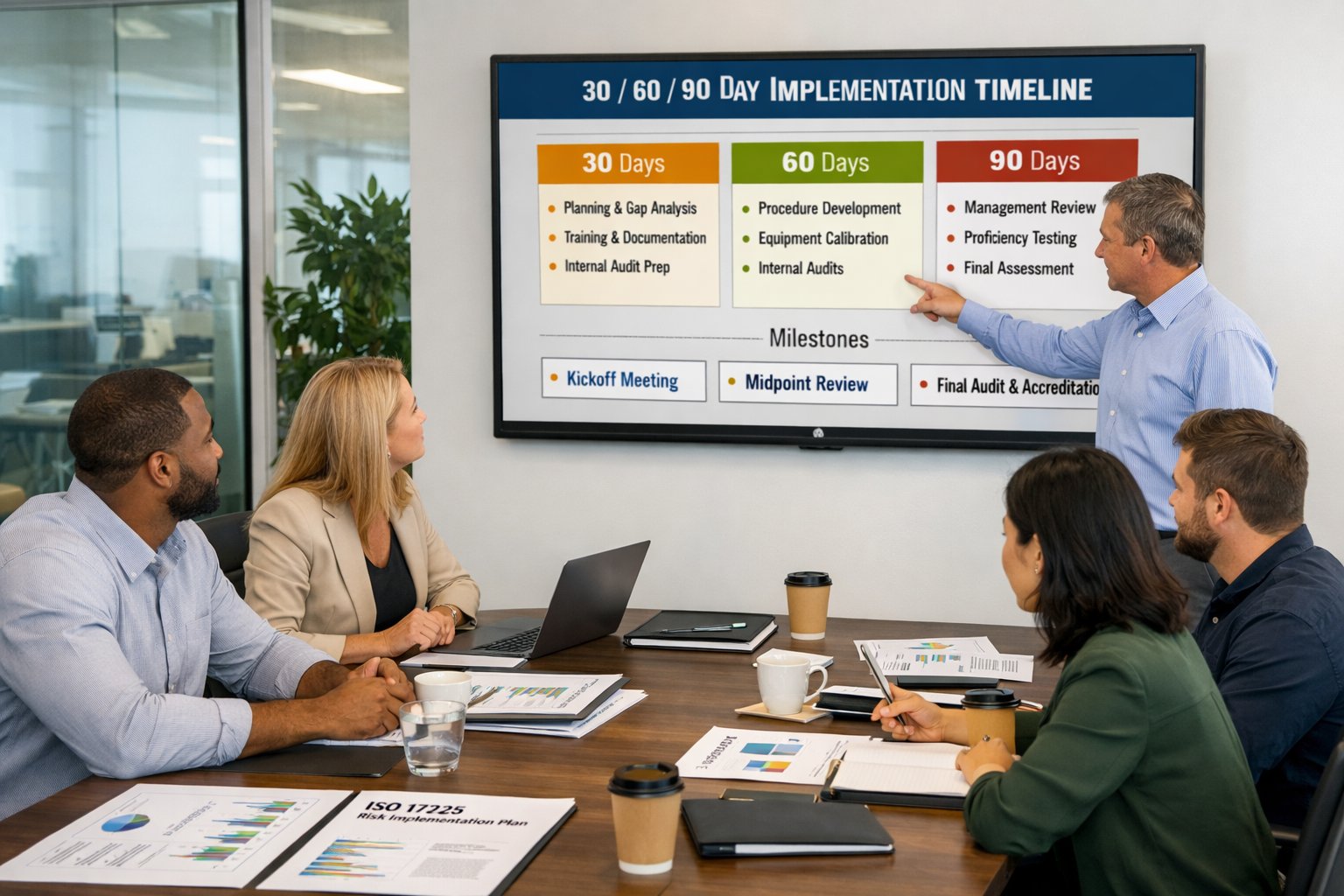
This section turns your ISO 17025 implementation timeline into a practical, execution-ready ISO 17025 implementation plan you can run over the next 90 days. You’ll move from planning, to building your management system, to proving technical competence with real records and results—the same kinds of evidence assessors expect to verify during an accreditation assessment.
How to use this plan: Pick one test or calibration as your “pilot job,” then build your system and evidence around it. Each phase below ends with specific outcomes and deliverables/records so you can see exactly what “ready” looks like.
Days 0–30 — Foundation + Gap Analysis + Project Setup
Start by defining your scope of accreditation. List the exact tests or calibrations you want to include, along with the ranges, matrices, methods, and key equipment you already use. Scope clarity is one of the biggest drivers of speed—when scope changes late, timelines slip and rework piles up.
Next, run a clause-by-clause gap analysis against ISO/IEC 17025:2017. Compare each requirement to what you actually do today in the lab. Record what exists, what needs improvement, and what is missing. Don’t overthink perfection here—the goal is a clear, honest baseline that you can execute against.
Set up the project structure early. Assign a quality owner (management system accountability) and a technical owner (technical validity accountability). Confirm management support and resource needs such as time, staffing, calibration services, reference materials, environmental controls, and any external services. Then create a simple project plan with owners and due dates—this becomes your control tool for the next 90 days and keeps work focused on accreditation needs rather than “busy work.”
Outcomes by Day 30
- Draft scope and scope matrix that won’t change later
- Clause-by-clause gap tracker with owners and due dates
- Basic document/record control structure started (so records are controlled from day one)
- Roles assigned with clear authority (quality + technical leadership)
Deliverables / Records to have in hand
- Scope statement + scope matrix (method / instrument / range / matrix)
- Gap analysis tracker (Clause → current practice → gap → owner → due date)
- Organization chart + roles/responsibilities (including impartiality/confidentiality responsibilities)
- Starter risk/opportunity log (top risks to impartiality + technical validity)
- Draft document register + starter record list (what records you will generate and retain)
Auditor’s Note: Assessors don’t audit intentions—they audit implemented controls and the records that prove they’re working.
Days 61–90 — Technical Readiness (Clauses 6 & 7) + Generate Audit-Ready Evidence
This is where many labs slow down—because Clause 6 and 7 readiness requires real technical evidence, not just management system documents. Your goal by Day 90 is to demonstrate technical competence across people, equipment, methods, and records.
Confirm competence and authorization. Training alone is not enough—define competence criteria, verify competence where needed (observation, witnessed work, review of results), and document authorization for staff to perform specific tasks.
Ensure equipment meets requirements. Verify calibration status, traceability, maintenance, intermediate checks (if applicable), and environmental controls where conditions affect results. Fix issues that could impact result validity and document what you did.
Document and apply test and calibration methods. Complete method verification or validation where required, and start generating routine technical records (raw data, calculations, reviews, and final reporting). Begin proficiency testing or other comparisons if available. If proficiency testing isn’t available, plan an appropriate alternative (e.g., interlaboratory comparisons, replicate testing, split-sample approaches) and document the justification.
Then run an internal audit using real records. Address nonconformities with documented corrective actions and effectiveness checks. By Day 90, your lab should show consistent operation and clear, audit-ready evidence that can be traced end-to-end. Here are some ISO 17025 nonconformity examples you can review.
Outcomes by Day 90
- Competence is demonstrated with verification + authorization records
- Equipment control is demonstrated with traceable records
- Methods are controlled and verification/validation is underway (or complete where applicable)
- Internal audit completed using real technical records
- Management review is scheduled (or completed if you’re moving fast)
Deliverables / Records to have in hand
- Training matrix + competence criteria + staff authorization records (who can do what)
- Equipment list + calibration/verification schedule + traceable certificates
- Environmental monitoring records (where conditions affect results)
- Method verification/validation plans + initial studies/results
- QC plan + QC records (controls, acceptance criteria, trends)
- Report template(s) aligned to Clause 7.8 (test report and/or calibration certificate)
- Internal audit report + NCRs + corrective actions + effectiveness checks
Auditor’s Note: A common end-to-end assessment technique is tracing one job from request → method → equipment → raw data → review → report. Your records should support that trace without gaps.
Can You Be Audit-Ready in 90 Days?
Some labs can be audit-ready in 90 days—but only when scope is tight and you can generate audit-ready records quickly. If you want a fast-track timeline, book a free 45-minute call and I’ll tell you whether a 90-day sprint is realistic for your lab (and what would have to be true).
Trying to be audit-ready in 90 days?
Some labs can hit a 90-day ISO 17025 timeline—but only with a narrow scope, strong management support, and rapid evidence generation.
- Best fit if your scope is tight and key records already exist (or can be generated fast).
- Not ideal if you’re still finalizing scope, commissioning major equipment, or validating many new methods.
In the call, we’ll confirm your scope and evidence readiness, then map the shortest realistic path to audit-ready records. If you qualify, I can also share what a 90-day engagement would look like (weekly cadence, deliverables, and what you’ll need to provide).
Month-by-Month Implementation Timeline (6–12 Month Example)

You can plan the ISO 17025 accreditation process across 6 to 12 months, depending on your scope of accreditation and available resources.
The outline below shows a common, realistic sequence. You may adjust the pace to match your lab size and technical complexity.
| Month | Main Focus | Key Activities |
|---|---|---|
| 1 | Planning and gap review | Define the scope of accreditation, run a gap analysis, and set roles and dates. |
| 2–3 | Documentation | Write or update the quality manual, procedures, and records that match daily work. |
| 4 | Training and use | Train staff and start using procedures to create real evidence. |
| 5 | Internal checks | Perform internal audits and complete management review actions. |
| 6 | Application stage | Finalize readiness and complete application submission to the accreditation body. |
| 7–9 | Assessment cycle | Support the assessment, answer findings, and close nonconformities. |
| 10–12 | Final approval | Wait for review, respond if needed, and receive the accreditation decision. |
You should avoid moving ahead before closing key actions. For example, don’t submit your application until audits and reviews show effective use.
Shorter projects often fit into six months when the scope of accreditation is narrow.
Larger or multi-discipline labs usually need closer to twelve months to manage assessments and corrective actions.
What Auditors Look For at Each Stage (Common Failure Points)
Auditors track how your system develops from planning to routine use. They focus on scope control, proof of daily use, staff competence, technical control, reporting accuracy, and how well you review and correct problems.
Scope & Impartiality Not Defined Early
Auditors expect a clear scope before the pre-assessment or initial accreditation assessment. You must define which tests or calibrations you offer, where you perform them, and which methods you use.
Vague scope statements create audit findings during document review or on-site assessment.
You also need written controls for impartiality. Lead assessors often ask who could influence results and how you prevent that risk.
Missing risk reviews or unsigned declarations signal weak control.
Common failure points include:
- Scope that changes between application and final assessment
- Impartiality risks not reviewed by management
- No records showing ongoing impartiality monitoring
These issues delay audit readiness and raise concerns during surveillance assessments.
Docs Exist but No Records/Evidence
Auditors don’t take documents alone as proof of ISO 17025 compliance. They want to see records that actually show staff follow procedures in daily work.
Technical assessors usually pick recent jobs and trace them from start to finish. You might pass document review but still fail the on-site assessment if records are missing.
This includes calibration data, test worksheets, equipment logs, and review signatures. High-risk gaps include:
- Blank forms or templates with no completed examples
- Records made just for audit prep
- Inconsistent dates, signatures, or version control
Competence Not Demonstrated (Training ≠ Authorization)
Auditors always separate training from competence. Training records by themselves don’t prove staff can actually perform work unsupervised.
You’ve got to show authorization for specific methods in your scope. Technical assessors tend to ask, “Who approved this analyst to run this method?”
If you can’t show clear evidence, you’ll get an audit finding. Strong evidence includes:
- Method-specific competence evaluations
- Authorization lists tied to scope and methods
- Periodic re-evaluation records
Method Verification/Validation Unclear
Auditors dig into method verification and validation. They expect you to match the level of study to the method type and what you’re using it for.
Standard methods don’t get you out of this requirement. During on-site assessment, technical assessors review data, acceptance criteria, and approvals.
Missing justification or unclear results? That’ll probably trigger nonconformities. Common problems include:
- No defined performance criteria
- Validation data not reviewed or approved
- Changes made without re-verification
Reports Missing Required Elements
Test and calibration reports get a close look during audits. Lead assessors and technical folks check reports against ISO 17025 clauses and your own procedures.
Missing or inconsistent report elements? That’s a direct audit finding, even if the technical work is fine. Auditors often flag:
- Missing uncertainty statements when needed
- No method identification or revision
- Incorrect use of accreditation symbols
Internal Audit / Management Review Rushed or Superficial
Auditors use internal audits and management review to judge how mature your system really is. They expect meaningful review—not a last-minute scramble before assessment.
Internal audits should cover all ISO 17025 clauses and technical activities. Management review needs to address risks, audit results, corrective actions, and resources.
Red flags?
- Audits crammed into one day with generic checklists
- No root cause analysis for findings
- Management review minutes with no decisions or actions
Required Evidence Checklist (Copy/Paste)
Here’s a checklist you can use to track the records and documents you’ll need for an ISO 17025 assessment. Try to keep each item current, approved, and easy to find.
Management system evidence
- Quality policy and quality objectives
- Quality manual aligned to ISO 17025 clauses
- Risk assessment records and actions
- Document control and record control procedures
- Evidence of control of documents and revisions
Technical and process evidence
- Standard operating procedures for testing and calibration
- Calibration procedures and testing methods in use
- Method validation or verification records
- Technical records showing actual test or calibration results
- Uncertainty calculations and measurement uncertainty budgets
Resources and competence evidence
- Training and competence records for all staff
- Authorization records for testing and calibration tasks
- Equipment calibration records and schedules
- Measurement traceability to recognized standards
- Evidence supporting measurement accuracy
Data and system evidence
- Controlled forms and logs used in daily work
- Use of quality management software, if applicable
- Backup and protection of electronic records
If you’re aiming for a shorter timeline, this checklist is the deciding factor. Bring it to a free 45-minute call and we’ll quickly mark what you already have vs. what’s missing. If scope is narrow and gaps are small, we can discuss a 90-day audit-ready sprint.
If you qualify, I can also share what a 90-day engagement would look like (weekly cadence, deliverables, and what you’ll need to provide).
Make sure your ISO 17025 documentation reflects how your lab actually works. Assessors look for consistency between what’s written and what happens—especially for testing and calibration activities.
Related ISO/IEC 17025 Resources
Might be worth checking out related ISO standards and guidance while you’re planning your ISO 17025 implementation timeline. These resources support different stages, from early planning all the way to assessment.
- What Is ISO 17025 Accreditation? Understanding Laboratory Competency And Standardization – RJ Quality Consulting
- How To Conduct An ISO 17025 Internal Audit RJ Quality Consulting
- ISO 17025 Management Review: Ensuring Laboratory Competence and Compliance – RJ Quality Consulting
It’s smart to check guidance from your chosen accreditation body too. Bodies like UKAS in the UK and ANAB, A2LA, or PJLA in the US publish rules, assessment steps, and typical timelines.
At the international level, ILAC provides frameworks that support mutual recognition between accreditation bodies. This matters if your lab works across borders or serves global clients.
The table below shows how these resources often line up with the timeline:
| Timeline Phase | Helpful Resource |
|---|---|
| Planning | ISO 17025 Gap Analysis |
| Implementation | ISO 9001 Alignment Guide |
| Assessment | UKAS / ANAB Requirements |
| Recognition | ILAC Guidance |
Get Help (Consultation-Focused Close)
You don’t have to handle the ISO 17025 timeline all by yourself. A focused consultation can help you plan each step, avoid rework, and keep your schedule realistic.
A qualified consultant can help with:
- Gap analysis tied to your test or calibration scope
- Document setup that matches how your lab works
- Staff training and clear competence records
- Internal audits that reflect accreditation expectations
- Application support and assessor-ready responses
You stay in control of decisions. The consultant provides structure, checks progress, and flags risks early.
You might want help if your timeline slips, your scope feels fuzzy, or your team lacks audit experience. Short-term support often works well during setup, internal audit, or pre-assessment.
Before you reach out, try to have these items ready:
- Your draft scope of accreditation
- A list of current methods and equipment
- Target dates and resource limits
| Area | How consultation helps |
|---|---|
| Planning | Sets clear milestones |
| Documents | Aligns to ISO 17025 clauses |
| Audits | Reduces major findings |
Targeted guidance keeps your implementation practical and on track, without piling on unnecessary work.
Frequently Asked Questions
Labs ask a lot about timelines, required documents, key processes, and staff training. These topics shape planning, resource use, and readiness for ISO 17025 accreditation.
What is the average duration for implementing ISO 17025 in a laboratory?
You can expect implementation to take about 6 to 12 months. The timeline depends on your lab size, test complexity, and current quality practices.
Labs with existing quality systems often move faster. New or complex labs usually need more time for setup and validation.
Which documents are essential for ISO 17025 accreditation?
You need a quality policy and quality objectives that match your scope of work. A quality manual or documented system description also supports compliance.
You must keep standard operating procedures, method validations, and equipment records. Internal audit reports, management review records, and training logs are also required.
What are the process requirements as specified in ISO/IEC 17025?
You must control testing and calibration methods from start to finish. This includes sample handling, method validation, and result reporting.
You also need controls for equipment, measurement traceability, and data integrity. Risk management and corrective actions support consistent results.
Can you outline the steps involved in obtaining ISO 17025 certification?
You start with management commitment and a gap analysis. Next, you define scope, document processes, and address risks.
You then implement procedures, train staff, and operate the system. Internal audits, management review, and an external assessment lead to accreditation.
What are the main changes in ISO/IEC 17025:2017 from its previous version?
The 2017 version adds a stronger focus on risk-based thinking. It also allows more flexibility in documentation structure.
The standard now emphasizes information technology and data security. It aligns more closely with other ISO management system standards.
Is training required for laboratory staff to comply with ISO 17025 standards?
Yes, you must train staff on technical methods and quality procedures. Training ensures staff can perform tasks correctly and consistently.
You also need to keep training records and review competence over time. Ongoing awareness supports continued compliance.
Conclusion
You can manage an ISO 17025 implementation if you treat it as a planned sequence of steps. Each phase builds on the last, so order and timing really matter.
Most labs move through preparation, documentation, training, internal review, and assessment over several months. Your actual timeline depends on your scope, staff size, and honestly, how much you already have in place.
Key actions that keep your timeline on track include:
- Do a gap analysis before you start writing documents.
- Use procedures that actually fit how your lab works.
- Train your staff early and record their competence along the way.
- Fix internal audit findings before you even think about applying.
If you fix issues as they pop up, you’ll avoid a pile-up of problems later. Waiting until the final assessment? That usually means more rework and extra costs—nobody enjoys that.
The table below gives you a rough idea of how the effort spreads across the project:
| Phase | Focus | Time Range |
|---|---|---|
| Preparation | Gaps and planning | Weeks |
| Implementation | Documents and use | Months |
| Verification | Audits and review | Weeks |
| Assessment | External review | Weeks |
Track your progress and make sure you assign clear owners for each step. Small, steady actions usually get you to accreditation with fewer surprises—and less stress on your team.
🕒 Book Your Free 45-Minute Consultation
Have questions about ISO/IEC 17025 or ISO 9001 implementation or accreditation? Schedule a free 45-minute consultation with me to discuss your Company or laboratory’s needs and how we can achieve compliance together.
Schedule Your Consultation