ISO 17025 Environmental Conditions: Clause 6.3 Guide
ISO 17025 environmental conditions are an important part of protecting the validity of testing and calibration results. Under ISO/IEC 17025 Clause 6.3, laboratories need to identify, control, monitor, and record the facility and environmental conditions that can influence laboratory activities or the validity of results.
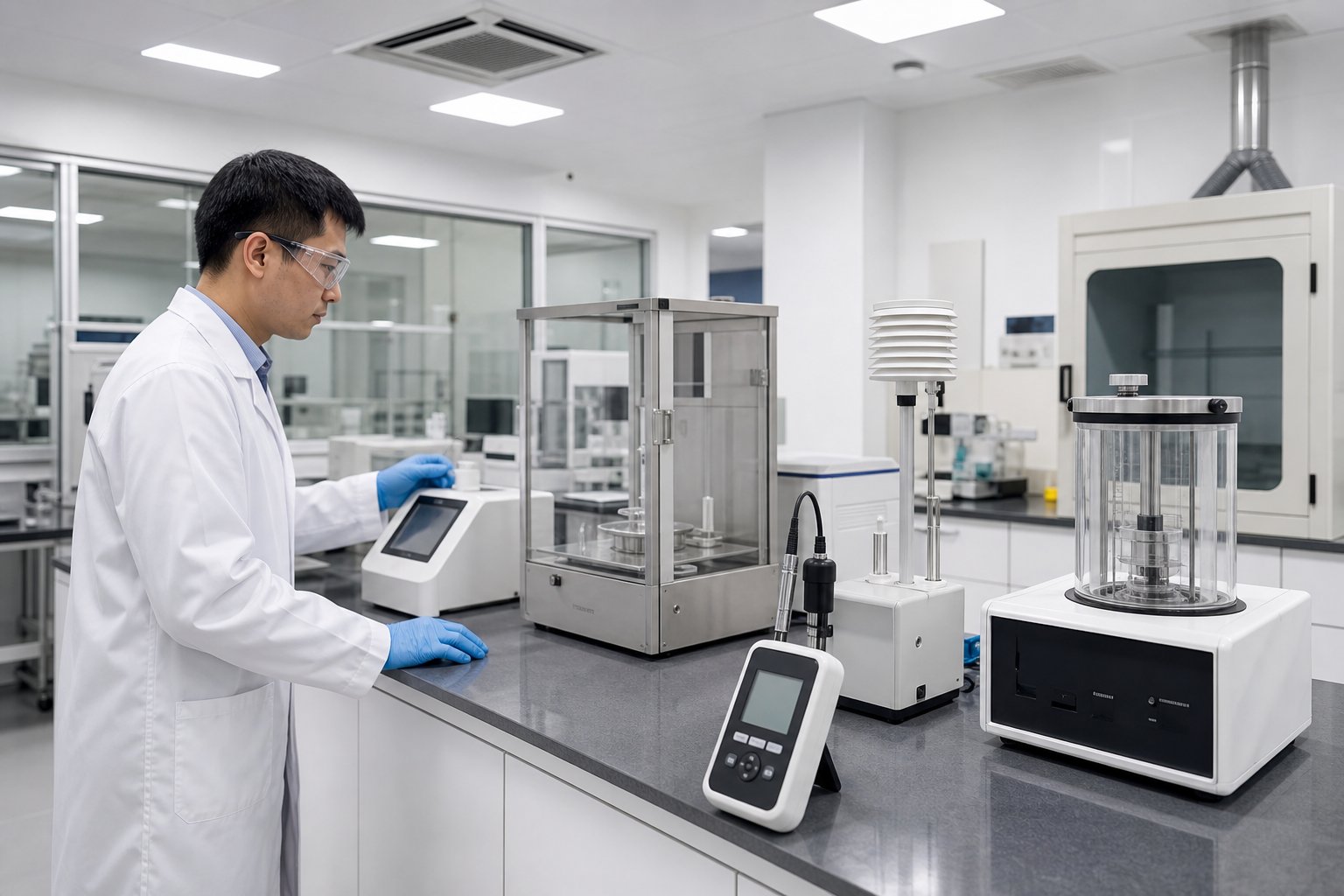
Temperature and relative humidity are common examples, but they are only part of the requirement. Depending on the laboratory’s activities, environmental influences may also include vibration, dust, contamination, air movement, electromagnetic interference, lighting, electrical supply, atmospheric pressure, cleanliness, and separation of incompatible activities.
ISO/IEC 17025 does not establish one universal temperature or humidity range for every laboratory. Appropriate requirements should come from the applicable method, equipment specifications, regulatory or customer requirements, measurement uncertainty considerations, validation or verification evidence, and the technical needs of the laboratory’s work. This guide explains how to establish those requirements, determine what and how often to monitor, select appropriate sensor locations, and evaluate the effect of an environmental excursion on laboratory results.
ISO/IEC 17025 is intended to help testing and calibration laboratories demonstrate competent operation and generate valid results.
Key Takeaways
- ISO/IEC 17025 does not prescribe one universal laboratory temperature or humidity range.
- Laboratories should identify environmental conditions that can influence their specific testing or calibration activities.
- Monitoring frequency, sensor placement, limits, and equipment controls should be technically justified and risk-based.
- An environmental excursion does not automatically invalidate laboratory results; its potential impact should be technically evaluated.
- Environmental monitoring records should demonstrate that applicable conditions were suitable when laboratory activities were performed.
Watch: ISO 17025 Environmental Conditions Explained
Prefer a video walkthrough? In this presentation, I explain ISO 17025 environmental conditions, including temperature and humidity requirements, environmental monitoring, limit setting, sensor placement, excursion response, and the types of evidence an assessor may review under Clause 6.3.
What Does ISO 17025 Clause 6.3 Require?
Clause 6.3 of ISO/IEC 17025:2017 covers facilities and environmental conditions. Really, the rule is pretty straightforward: your lab space and environmental conditions can’t mess up your results or drag down your measurement quality.
The standard tells you to figure out which conditions matter for your methods, and then keep those in check.
Here’s what you need to do for any condition that could affect your results:
| Action | What it means in practice |
|---|---|
| Document | Write down the required ranges and limits |
| Control | Use equipment and procedures to hold conditions steady |
| Monitor | Check conditions during laboratory activities |
| Record | Keep logs that show conditions stayed in range |
You’ll probably need to manage things like temperature, humidity, dust, vibration, lighting, power supply, biological sterility, and electromagnetic interference.
Clause 6.3 also wants you to set and control access to the areas where lab work happens. If different types of work could interfere with each other, keep them apart and avoid cross-contamination.
You need to keep the lab clean and organized. When an applicable environmental requirement is exceeded, the laboratory should evaluate the significance of the excursion and control affected work as necessary. Depending on the method, magnitude and duration of the excursion, available QC evidence, and potential effect on results, this could range from documenting that there was no meaningful impact to suspending work and initiating the laboratory’s nonconforming-work process.
This all goes for off-site work, too. If you’re testing or calibrating at a customer’s location or out in the field, you still need to control the environment as much as possible.
The standard doesn’t tell you what numbers to use for temperature or humidity. You get those from your test methods, equipment manuals, or reference standards. Clause 6.3 just expects you to meet those requirements—and be able to prove it.
Does ISO 17025 Specify Temperature and Humidity Requirements?
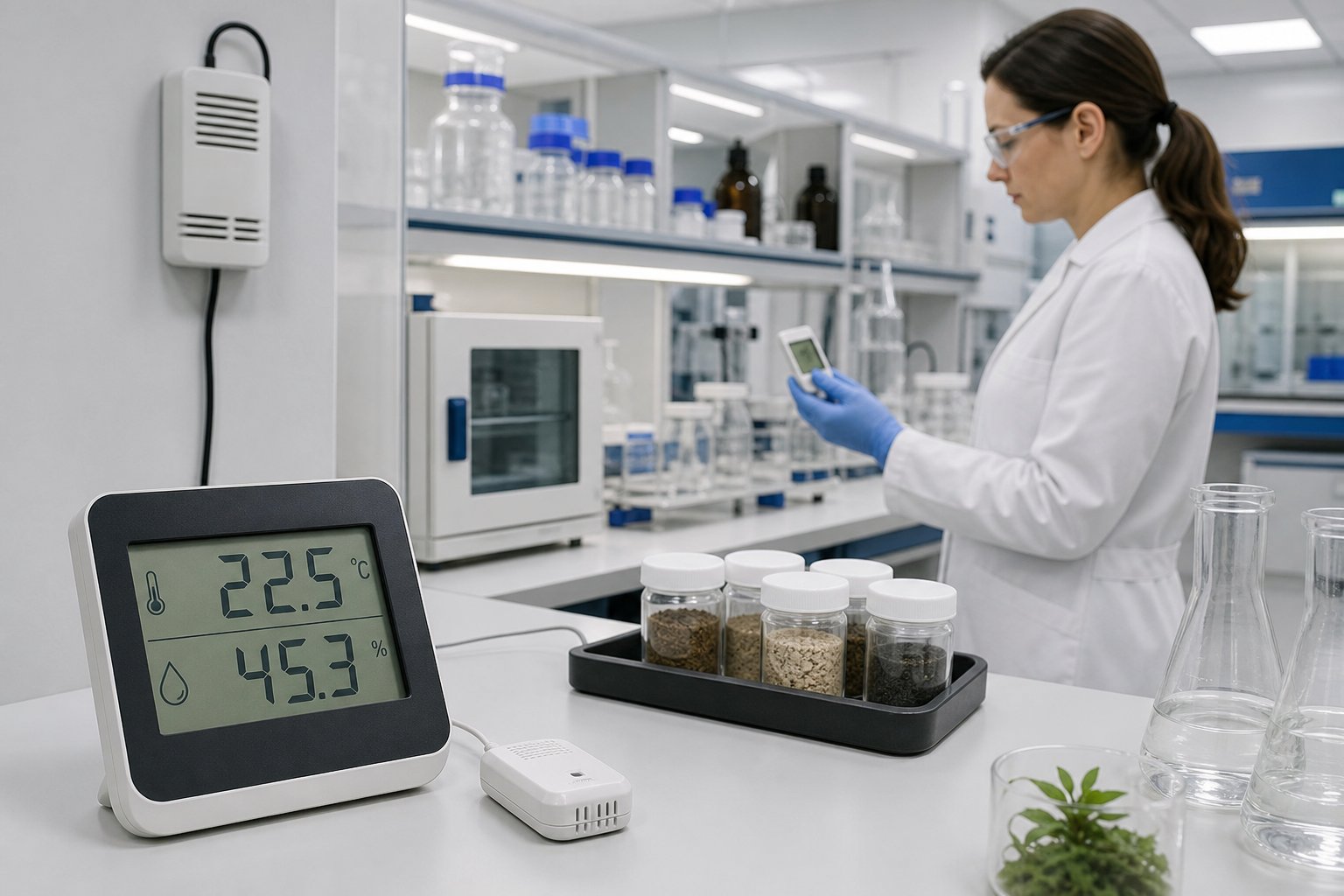
Short answer: nope. ISO/IEC 17025:2017 doesn’t give you exact numbers for temperature or humidity.
You won’t see anything in there saying your lab must stay at 20 °C and 45% relative humidity. Instead, Clause 6.3 just tells you to control your environment so your results stay valid.
What you actually need to do:
- Document the environmental conditions your methods need
- Monitor and record those conditions
- Keep them in range so your results are trustworthy
- Stop work if things go outside your limits
So, where do you get the numbers? Usually from one of three places:
| Source | Example |
|---|---|
| The test or calibration method | ASTM or ISO methods often state exact ranges |
| Equipment manufacturers | Instrument specs may require a set range |
| Your own uncertainty budget | Tighter control lowers measurement uncertainty |
A lot of dimensional calibration labs use 20 °C as a reference temperature. That’s really just a measurement convention, not something ISO 17025 forces on you.
Your limits should fit the work you do. If you’re measuring gauge blocks, you need much tighter control than if you’re running basic chemistry tests.
That flexibility is on purpose. One set of numbers wouldn’t work for every lab, so the standard leaves the decision to you.
Just be ready to explain your choices. If you get audited, you’ll need to show how you picked your limits and what evidence backs them up.
Which Environmental Conditions Can Affect Laboratory Results?
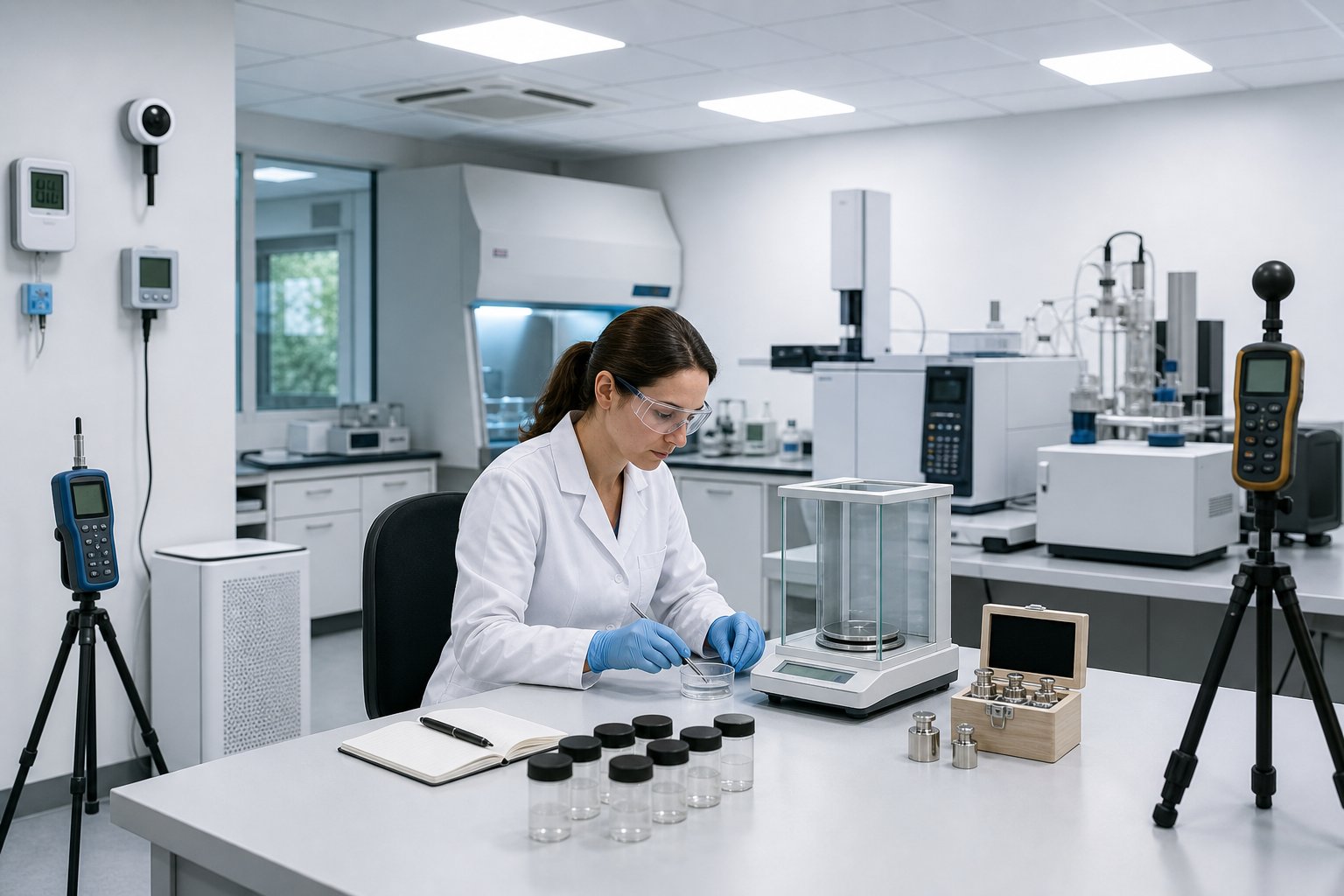
Ten environmental factors pop up all the time in method requirements and audit findings: temperature, relative humidity, air pressure, air movement, vibration, dust, electromagnetic interference, lighting, electrical supply, and biological contamination. Any one of these can mess with a measurement, damage a sample, or void a calibration certificate if you just ignore it.
Temperature
Temperature requirements can vary substantially by laboratory activity. Certain dimensional measurements, for example, may use a defined reference temperature and require tight environmental control because thermal expansion can materially affect the result. Other testing activities may tolerate a much wider range. The laboratory should therefore establish temperature requirements from the applicable method, equipment specifications, uncertainty evaluation, regulatory requirements, and intended use rather than adopting a generic laboratory range
Relative Humidity
Relative humidity affects mass, moisture content, and static charge. Paper, textiles, soil, and powders all soak up water from the air, so their weight changes as humidity shifts.
Relative humidity requirements should likewise reflect the activity. Humidity may influence hygroscopic materials, static charge, corrosion, sample stability, certain electrical measurements, and mass determinations. Where humidity can materially influence results, the laboratory should define an appropriate range and monitoring approach based on objective technical requirements.
You’ll probably need a dehumidifier or an HVAC system with reheat to keep things steady. A hygrometer just tells you there’s a problem; it won’t fix anything by itself.
Environmental monitoring devices used to demonstrate conformity with specified conditions should be appropriately controlled. Calibration or verification requirements and intervals should reflect the device’s intended use, required accuracy, stability, risk, and applicable metrological traceability requirements.
Air Pressure
Air pressure doesn’t always matter, but when it does, it really does. Barometric pressure affects gas volume measurements, air buoyancy corrections in ultra-precise weighing, and pressure instrument calibration.
If you’re weighing at the microgram level, you need pressure, temperature, and humidity together to calculate air density and apply buoyancy corrections.
Where differential pressure is technically important—for example, to control contamination or airflow between laboratory areas—the laboratory should define the required pressure relationship, monitoring method, and response to loss of control based on the applicable activity and requirements.
Monitor differential pressure with a gauge or transducer and set an alarm. Leave a door open and you can flip the airflow in seconds.
Air Movement
Moving air pulls heat away from surfaces and messes with sensitive instruments. If you put an analytical balance under an HVAC diffuser, it’ll never settle—no matter how fancy the balance is.
Air currents can also create temperature gradients you didn’t plan for, especially on test specimens.
Some fixes:
- Move balances away from vents, doors, and walkways
- Use draft shields and anti-vibration tables
- Install diffusers that spread air sideways, not straight down
- Keep fume hood sashes at the right height
Fume hoods move a ton of air, so if you’ve got one near a balance bench, expect a steady draft.
Vibration
Vibration comes from foot traffic, compressors, centrifuges, HVAC gear, and even nearby roads or trains. You’ll see it as unstable readings on balances, blurry microscope images, or scatter in hardness testing.
Ground-floor or basement labs usually vibrate less than upper floors. If you can’t move the instrument, isolate it.
Common ways to isolate:
| Method | Typical use |
|---|---|
| Marble or granite bench | Analytical balances |
| Pneumatic isolation table | Microscopes, interferometers |
| Rubber or spring mounts | Pumps, compressors |
| Separate concrete plinth | Coordinate measuring machines |
Try taking repeat readings during quiet hours and again during busy times. If a meaningful difference is observed, investigate whether vibration is contributing to measurement variability and whether additional controls are necessary.
Dust and Contamination
Dust settles on optics, contaminates samples, and adds weight to balances. In trace metals analysis, a single dust particle can give you a false positive.
Depending on the activity and contamination risk, possible controls may include:
- Filter incoming air—HEPA filters for critical zones
- Use tacky mats at doors
- Keep sample prep and instrument rooms separate
- Store glassware covered
- Keep cardboard and paper towels out of clean areas
Cross-contamination is a common audit target. If you’re testing water and soil, don’t prep both on the same bench unless you clean up and have a documented process.
Grinding, sieving, and ashing make a mess—give those jobs their own room and exhaust.
Electromagnetic Interference
Electromagnetic interference can affect sensitive electronic measurements and instrumentation. Motors, radios, mobile phones, welders, fluorescent lights, VFDs, and other instruments nearby can all cause issues.
Look for unstable digital displays, noisy low-voltage signals, or readings that jump when someone turns something on nearby.
To control EMI:
- Shielded cables for low-level signals
- Proper grounding with a single reference point to avoid ground loops
- Physical separation between noisy gear and sensitive instruments
- Faraday cages for really low signal work (like electrometer calibration)
If you’re near a transmitter or industrial site, check for radio frequency interference and write down what you find. Assessors will want to know how you identified the risk.
Lighting
Lighting really shapes both how well you can see details and how comfortable operators feel during inspection. Not enough light? People miss defects or misread scales. Too much glare, though, and everyone’s squinting, making mistakes because their eyes hurt.
Lighting requirements should be based on the laboratory activity. Visual inspection, color evaluation, microscopy, reading graduations, and other visually dependent activities may require defined illumination or a specified light source. Where lighting can affect the validity of the activity, establish and document appropriate requirements from the applicable method, standard, or technical evaluation.
Colour temperature isn’t just a fancy spec; it actually matters for things like colour matching or reading stains. If your method calls for a standardized light source (like D65), use it.
UV light can wreck some samples and reagents, so stash sensitive stuff in amber bottles or keep it tucked away in dark cabinets.
Electrical Supply
When your power supply jumps around, it’s not just annoying—it can actually damage instruments and mess up your data. Voltage dips, spikes, harmonics, even quick outages all show up as failed runs or weird calibration drift.
Depending on equipment sensitivity and risk, possible controls may include:
- Surge protection on every instrument
- Voltage regulation if your mains supply isn’t rock solid
- UPS to ride out short blips and let you shut down safely
- Generator backup for longer outages, especially if you’re storing samples
Keep big motor loads (like freezers) on their own circuits, away from sensitive measuring instruments. If a compressor kicks on the same line as your spectrometer, you’ll actually see the voltage dip.
Make a habit of logging power events. If you lose power mid-test, you’ll want that info to help decide if the results are still good.
Cleanliness and Biological Contamination
Cleanliness isn’t just about air—think surfaces, equipment, and people too. In microbiology and food labs, biological contamination can easily ruin your results.
Write up a cleaning schedule. Be clear about what gets cleaned, how often, and who’s on the hook for it. Different spaces need different levels:
| Area | Typical requirement |
|---|---|
| General office | Routine cleaning |
| Sample receipt | Daily surface disinfection |
| Microbiology prep | Disinfection before and after each session |
Don’t just assume your cleaning works—check it. Use settle plates, contact plates, or swabs to get actual evidence.
Control who gets in. Use a badge system or a sign-in log, and make lab coats and gloves a must in the right zones. People moving around are, honestly, one of the biggest contamination risks in any lab.
Focus on:
- Cross-contamination
- Cleaning
- Segregation
- Appropriate protective clothing
- Controlled access
- Monitoring where technically necessary
How to Determine Which Environmental Conditions Need Monitoring
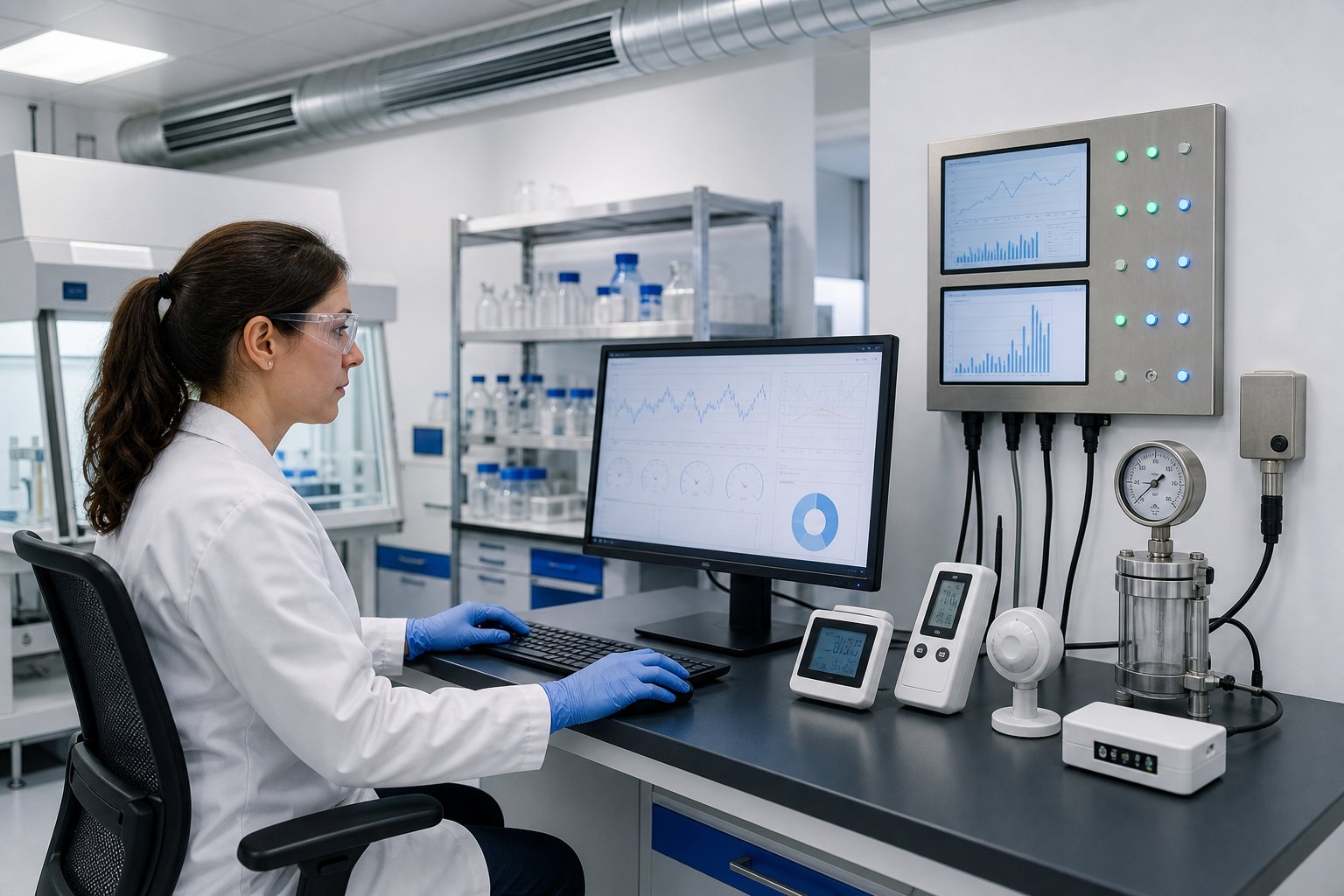
Start with your test methods. Most standards and manufacturer manuals spell out the conditions your work depends on—temperature, humidity, vibration, you name it.
If a method calls out a specific condition, you monitor it. If it doesn’t, you’ll need to make a call based on what you know and what the evidence says.
Your measurement uncertainty budget is a great tool here. Build it out for each method and see which environmental factors actually contribute to your overall uncertainty. If something adds real error, it belongs in your monitoring plan.
A quick risk assessment helps too. Ask yourself: what happens if a condition drifts out of range during a run? Could it mess up the results?
Some conditions that usually matter:
| Condition | When It Matters |
|---|---|
| Temperature | Dimensional work, calibration, chemistry |
| Humidity | Electronics, paper, hygroscopic materials |
| Dust and contamination | Microbiology, trace analysis, sampling |
| Vibration | Balances, microscopes, precision gauges |
| Electromagnetic interference | Electrical and electronic measurements |
| Lighting | Visual inspection and color work |
Your monitoring equipment is just as important as your plan. Monitoring equipment should be suitable for its intended use. Where the measurement is needed to demonstrate conformity with an environmental requirement that can influence laboratory results, the laboratory should determine the necessary accuracy, resolution, calibration or verification, and metrological traceability appropriate to that use.
Keep those calibration certificates handy—you never know when you’ll need to prove your sensors are legit. Check the actual range, too. If your sensor only reads to ±2 °C but your method needs ±0.5 °C, well, that’s not going to cut it.
Finally, connect monitoring to your staff. Set clear competence requirements and train people so they know the limits, how to record readings, and when to stop work (and flag results) if something’s off.
How to Establish Environmental Limits
Don’t just guess at your limits—find evidence. Start with your test method or calibration procedure. A lot of standards will spell out exact conditions.
A method requirement isn’t necessarily a statistical “control limit.”
Use:
Method requirement: The acceptable environmental condition specified by the method.
Laboratory operating range: An internal range selected to maintain suitable conditions.
Warning limit: An optional internal threshold that signals conditions are approaching an unacceptable level.
Action limit: A defined point at which the laboratory takes specified action.
Check these sources first:
- The published test or calibration method
- Equipment manufacturer specs
- Reference material or standard certificates
- Accreditation body guidance
- Your own uncertainty budget
Test how much your results change as conditions shift. Run the same sample at different temperatures or humidity levels, then see what happens. If the change pushes your measurement uncertainty up, tighten the limit.
Where useful, establish an internal warning threshold inside the applicable environmental requirement or action boundary so personnel have an opportunity to respond before conditions become unacceptable.
Make sure your environmental control systems can actually hold the limits you set. A single HVAC unit might keep temperatures steady, but it could struggle with humidity—so you might need separate humidification or dehumidification gear.
Write each limit right into your procedures. Spell out the parameter, the range, how often you’ll monitor, and exactly what staff should do if a limit gets crossed.
Can Warning and Action Limits Help?
Warning and action limits can be useful management tools when environmental conditions may approach a method or laboratory requirement, but ISO/IEC 17025 does not require every laboratory to establish both types of limits.
A warning limit means you’re getting close to the edge of what’s acceptable. Reaching an action limit should trigger the response defined by the laboratory. Depending on the activity and risk, this may include holding work, evaluating environmental conditions, performing additional QC, assessing potentially affected results, or initiating nonconforming-work controls.
Here’s how they stack up:
| Limit type | What it means | What you do |
|---|---|---|
| Warning | Conditions are approaching an applicable requirement or internal action boundary | Increase observation, check the environmental-control system, review trends, and document the response as required |
| Action | A defined threshold or environmental requirement has been reached or exceeded | Follow the predefined response, which may include holding affected work, confirming the condition, evaluating technical impact, performing additional checks, or initiating nonconforming-work controls |
Let’s say your method needs 20 °C ± 2 °C. Maybe set a warning at 21.5 °C and an action limit at 22 °C.
That little gap gives your team a chance to tweak the HVAC before you’re out of range.
Base your limits on the method, not just what you’ve always done. Test methods, calibration procedures, and equipment manuals usually have the right numbers.
Some tips:
- Write your limits into a documented procedure
- Make sure staff know who’s responsible for what
- Review monitoring data regularly to catch repeat drift
- Adjust limits if your method or equipment changes
If you keep hitting warnings, that’s usually a sign of a bigger problem—maybe an old chiller, or just a door that keeps getting left open.
How Often Should Environmental Conditions Be Monitored?
ISO/IEC 17025 doesn’t set a hard schedule. Clause 6.3.3 just says you need to monitor, control, and record any conditions that could affect your results. How often? That’s up to you and your methods.
Your test methods are really your best guide. If a standard or manual says you need to stay within a certain temperature or humidity range, monitor often enough to prove you did, start to finish.
Here are some Illustrative Examples:
| Monitoring type | Typical frequency | When it fits |
|---|---|---|
| Continuous data logging | Every 1–15 minutes | Rooms with tight limits, unattended testing, overnight runs |
| Per-test recording | At the start and end of each test | Methods that require conditions at the time of measurement |
| Scheduled manual checks | Daily or per shift | Stable rooms with wide tolerance ranges |
| Periodic surveys | Monthly, quarterly, or yearly | Vibration, lighting, electromagnetic interference, air quality |
Crank up your monitoring frequency when:
- Method tolerances are narrow
- Your building has wild temperature swings
- Your HVAC has let you down before
- Testing runs long without anyone in the room
You can relax the frequency, but only if your data backs you up. Check several months of records first, then write down why you made the change.
Review the monitoring plan when changes in methods, equipment, laboratory layout, environmental-control systems, historical performance, or other relevant factors indicate that the existing controls may no longer be appropriate. A laboratory may also establish a periodic review interval as part of its management system
Keep your records, no matter what. Assessors will ask, and it’s tough to justify missing data after the fact.
Where Should Environmental Sensors Be Located?
Where you put your sensors matters just as much as how accurate they are. If you stick one in the wrong spot, the reading won’t really tell you much about the conditions your samples or equipment actually deal with.
Put your calibrated sensors right where you’re measuring—don’t just slap them on a wall by the door because it’s easy.
Key placement rules:
- At bench height, near where you actually do testing or calibration
- Close to sensitive equipment—balances, gauge blocks, incubators, that sort of thing
- Away from HVAC vents, doors, windows—anywhere you get weird drafts or temperature swings
- Away from direct sunlight and heat sources (ovens, computers, lighting, etc.)
- Inside enclosures (chambers, fridges, freezers), not just the open lab space
Big rooms almost never have the same temperature everywhere. Warm air likes to hang out near the ceiling, and cold drafts pool around floors and doors.
A temperature mapping study will help you spot these differences. Where significant environmental gradients are possible, an environmental mapping study can help determine representative sensor locations.
| Area | What to Monitor | Typical Sensor Position |
|---|---|---|
| Calibration room | Temperature, humidity | Bench level, next to the artifact |
| Sample storage | Temperature | Inside unit, at product level |
| General test area | Temperature, humidity | Central, 1–1.5 m above floor |
| Cleanroom | Particles, pressure | Near critical work zone |
Document exactly where you put every sensor. Auditors will absolutely ask why a sensor’s in a certain spot, and your mapping report should back up your choices.
Check placement again if you move equipment, change the room layout, or mess with the HVAC.
Example ISO 17025 Environmental Monitoring and Control Matrix
The following example shows how a laboratory can organize its ISO 17025 environmental conditions into a practical monitoring and control matrix. The specific parameters, limits, frequencies, and responses should be based on the laboratory’s own methods, equipment, measurement uncertainty, customer requirements, regulatory obligations, and risk.
| Laboratory Activity | Environmental Parameter | Monitoring & Limits | Required Response |
|---|---|---|---|
| Dimensional Calibration | Temperature | Continuous or activity-based monitoring using a suitable calibrated temperature sensor. Limits should be based on the calibration procedure, reference-standard requirements, and uncertainty budget. | Hold or suspend affected calibrations when required. Confirm the excursion, allow equipment and items to re-equilibrate, and evaluate whether previous results or measurement uncertainty were affected. |
| Mass / Balance Calibration | Temperature, relative humidity, air movement, vibration | Monitor conditions at or near the measurement location. Frequency should reflect the sensitivity of the balance, duration of the activity, air-density requirements, and historical room stability. | Stop work when conditions could invalidate the measurement. Investigate drafts, vibration, HVAC conditions, or environmental instability and assess any effect on uncertainty or previously completed calibrations. |
| Chemical Testing | Temperature, humidity, contamination, electrical supply | Establish monitoring based on method requirements, reagent and instrument specifications, sample stability, and the potential effect of environmental conditions on analytical performance. | Evaluate instrument performance, QC results, samples, reagents, and affected batches. Hold results where necessary and apply the laboratory’s nonconforming-work process if validity is uncertain. |
| Microbiological Testing | Temperature, cleanliness, contamination, pressure or airflow where applicable | Monitor conditions according to the method, facility design, contamination-control plan, incubator requirements, and applicable regulatory or sector requirements. | Evaluate potential contamination, affected cultures or samples, environmental monitoring results, and run controls. Repeat or reject work when the validity of results cannot be demonstrated. |
| Sample Storage | Storage temperature, humidity, light exposure | Use monitoring appropriate to sample stability and preservation requirements. Refrigerators, freezers, or controlled rooms may require continuous logging and alarm limits. | Confirm the duration and magnitude of the excursion. Evaluate sample stability, holding-time requirements, and whether samples remain suitable for testing. Document disposition decisions. |
| Field Sampling or On-Site Testing | Ambient temperature, weather, dust, lighting, sample preservation | Record relevant field conditions at the time of sampling or testing. Requirements should come from the sampling plan, test method, preservation requirements, and equipment specifications. | Document the deviation, determine whether sampling or testing can proceed, evaluate sample integrity or result validity, and obtain customer or technical approval where required. |
The purpose of an environmental monitoring matrix is not simply to create another laboratory record. It should connect each sensitive laboratory activity to the environmental condition that matters, the technical basis for the limit, the monitoring approach, and the action required when conditions become unacceptable. An assessor should be able to select a completed test or calibration and trace the applicable environmental requirements and monitoring records for the date the work was performed.
Environmental Conditions and Measurement Uncertainty
Environmental conditions can contribute directly to measurement uncertainty, particularly when temperature, humidity, atmospheric pressure, vibration, or other environmental factors influence the measurement process. This is especially important in calibration laboratories, but it can also apply to testing activities where environmental variation affects equipment performance, sample properties, reference standards, or the measurand itself.
When developing an uncertainty budget, the laboratory should consider whether environmental conditions represent a significant source of uncertainty. For example, temperature can affect dimensional measurements through thermal expansion, atmospheric conditions can influence high-accuracy mass measurements through air-buoyancy effects, and temperature can affect volumetric measurements through changes in liquid and vessel volume.
Environmental monitoring records can also provide objective evidence supporting the assumptions used in the laboratory’s uncertainty evaluation. If an uncertainty budget assumes that a calibration room remains within a defined temperature range, the laboratory should have sufficient monitoring data to demonstrate that those conditions are actually maintained during the measurement activity.
Examples of environmental factors that may contribute to measurement uncertainty include:
- Temperature — thermal expansion, instrument response, reference-standard stability, and sample properties
- Relative humidity — hygroscopic materials, static electricity, electrical measurements, and sample stability
- Atmospheric pressure — air-density and buoyancy corrections, gas-volume measurements, and certain pressure measurements
- Air movement — balance stability, temperature gradients, and sensitive mass measurements
- Vibration — repeatability and stability of balances, dimensional equipment, microscopes, and other sensitive instruments
- Electromagnetic interference — noise or instability in sensitive electrical and electronic measurements.
The important point is that the environmental limits established under ISO 17025 environmental conditions should be consistent with the assumptions used elsewhere in the laboratory’s technical system. A laboratory should not, for example, base its measurement uncertainty on temperature being controlled within a narrow range while its Clause 6.3 procedure permits a substantially wider range without evaluating the effect.
If actual environmental conditions exceed the range assumed in the uncertainty evaluation, the laboratory should determine whether:
- The existing measurement uncertainty remains valid
- The uncertainty contribution needs to be recalculated or increased
- Additional quality-control or check-standard data can demonstrate that performance remained acceptable
- The test or calibration should be repeated
- The reported result remains suitable for its intended use
- Nonconforming-work controls need to be initiated
An environmental excursion therefore does not automatically invalidate a test or calibration result. The laboratory should evaluate the magnitude and duration of the excursion, sensitivity of the measurement to that condition, available QC evidence, and the assumptions used in the uncertainty budget before reaching a technical conclusion.
For a more detailed explanation of identifying uncertainty contributors and developing an uncertainty budget, see my guide to ISO 17025 measurement uncertainty.
Controlling Access to Laboratory Areas
ISO/IEC 17025 Clause 6.3 is not limited to temperature, humidity, and other physical environmental conditions. Laboratories should also control access to areas where unrestricted entry could affect the validity of laboratory activities, introduce contamination, disturb sensitive equipment, or compromise the security of samples, reference standards, and technical records.
The level of access control should be based on the work being performed and the potential risk. A general chemistry laboratory may need only basic restrictions, while a microbiology area, clean room, reference-standard storage area, or high-accuracy calibration room may require much tighter control.
Possible access controls include:
- Badge or key-card access
- Locked laboratory doors
- Authorized-personnel lists
- Visitor sign-in requirements
- Escort requirements for visitors or contractors
- Restricted access to sample-storage areas
- Controlled access to reference standards
- Clean-room gowning or protective-clothing requirements
- Limits on food, beverages, personal items, or unnecessary materials
- LIMS or electronic access controls for environmental monitoring systems
- Defined rules for maintenance personnel entering sensitive areas
Access control should support the technical requirements of the laboratory rather than exist only as a security measure.
For example, uncontrolled traffic through a dimensional calibration room may introduce temperature changes, air movement, and vibration. Unrestricted entry into a microbiology preparation area may increase contamination risk. Frequent opening of a sample-storage room can cause temperature instability. In each case, access control helps protect the environmental conditions needed for valid laboratory work.
The laboratory should also define what happens when someone who is not normally authorized needs temporary access. This may include maintenance personnel, equipment vendors, contractors, customers, or assessors. Where appropriate, the laboratory should establish temporary access rules, supervision requirements, protective clothing, or restrictions on when sensitive work can be performed.
A practical access-control procedure should address:
- Which areas are restricted
- Who may enter those areas
- How authorization is granted
- How visitors are controlled
- Whether protective clothing is required
- Whether maintenance or cleaning activities are restricted during testing or calibration
- How access violations are handled
- How access-control records are retained, where needed
The laboratory should periodically review whether its access controls still match the activities being performed. A new method, instrument, sample type, or facility layout may change the level of control required.
A useful internal-audit question is:
Could unauthorized or unnecessary personnel movement through this area affect the environment, contaminate the work, disturb sensitive equipment, or compromise the validity of results?
If the answer is yes, the laboratory should have controls in place that are appropriate to the risk.
Separating Incompatible Laboratory Activities
ISO/IEC 17025 Clause 6.3 also requires laboratories to prevent adverse effects when different activities could interfere with one another. In practice, this means the laboratory should identify **incompatible activities** and provide enough physical or procedural separation to prevent contamination, interference, or other conditions that could affect the validity of results.
Not every activity needs its own room. The level of separation should reflect the actual risk.
Examples of potentially incompatible activities include:
- Trace-level metals preparation near high-concentration standards or samples
- Microbiology work near chemical sample preparation
- Clean calibration work near repair, machining, grinding, or maintenance activities
- Analytical balances near centrifuges, compressors, or other vibration-producing equipment
- Low-level electrical measurements near high-power equipment or electromagnetic sources
- Sterile work near routine sample-receiving areas
- Reference-standard preparation near general sample preparation
- Volatile chemical work near activities sensitive to fumes or contamination
- High-dust operations such as grinding, sieving, or ashing near sensitive instrumentation
- Clean sample storage near uncontrolled receiving or unpacking areas
The laboratory should first determine what type of interference could occur. This may involve:
- Cross-contamination
- Dust
- Aerosols
- Chemical vapors
- Biological contamination
- Vibration
- Air movement
- Electromagnetic interference
- Temperature changes
- Humidity changes
- Noise where it affects observation or measurement
- Physical disturbance of samples, standards, or equipment
Physical Separation
Where the risk is significant, physical separation may be the most effective control.
Examples include:
- Enclosed preparation areas
- Clean benches
- Fume hoods
- Biological safety cabinets
- Dedicated sample-preparation spaces
- Separate reference-standard storage
- Dedicated calibration rooms
- Local exhaust ventilation
- Barriers or partitions
- Separate rooms
Procedural Separation
Physical separation is not always necessary or practical. In lower-risk situations, the laboratory may use procedural controls such as:
- Performing incompatible activities at different times
- Cleaning and verifying the work area between activities
- Using dedicated tools, glassware, or consumables
- Restricting sample types processed in a specific area
- Scheduling high-contamination activities outside sensitive measurement periods
- Using protective covers or enclosures
- Applying one-way workflow
- Separating clean and dirty materials
- Controlling personnel movement between areas
For example, a laboratory may use the same preparation room for two different sample types if the risk of carryover is controlled through scheduling, cleaning, dedicated equipment, and documented verification. In contrast, highly sensitive trace analysis may require permanent physical separation because procedural controls alone would not sufficiently reduce the contamination risk.
How to Determine Whether Separation Is Adequate
The laboratory should be able to explain:
1. Which activities could interfere with one another
2. What the potential effect on results could be
3. Which controls were selected
4. Why those controls are considered sufficient
5. How the laboratory verifies that the controls remain effective
Evidence may include:
- Facility layouts
- Contamination-control procedures
- Cleaning records
- Environmental monitoring data
- Blank results
- Control-sample results
- Equipment-placement studies
- Vibration or electromagnetic-interference evaluations
- Internal-audit results
- Nonconforming-work investigations
The goal is not simply to create physical distance between activities. The goal is to demonstrate that one laboratory activity does not adversely affect another.
A useful internal-audit question is:
Could work being performed in this area influence another test, calibration, sample, reference standard, or piece of equipment nearby?
If so, the laboratory should define and document controls that are appropriate to the level of risk.
Environmental Conditions for Field and On-Site Laboratory Activities
The requirements for ISO 17025 environmental conditions do not end at the laboratory door. When testing, calibration, or sampling is performed at a customer facility, in a mobile laboratory, or at a field location, the laboratory should determine whether the surrounding conditions are suitable for the planned activity.
Off-site work can introduce environmental influences that are easier to control inside a permanent laboratory, including:
- Outdoor temperature and humidity
- Wind, rain, dust, or direct sunlight
- Unstable or unsuitable electrical power
- Vibration from machinery, vehicles, or nearby operations
- Inadequate lighting
- Limited workspace
- Electromagnetic interference
- Contamination from the customer’s processes
- Lack of temperature-controlled sample storage
- Restricted access to the work area
- Interruptions by customer personnel or other contractors
Before beginning the activity, the laboratory should identify the environmental requirements that apply and determine how those conditions will be checked, controlled, and documented.
Pre-Job Environmental Review
A practical pre-job review may include:
- The applicable test, calibration, or sampling method
- Equipment operating requirements
- Required temperature, humidity, pressure, or other environmental conditions
- Sample or calibration-item stabilization needs
- Electrical power and grounding requirements
- Space, lighting, cleanliness, and access needs
- Sample-preservation and transportation requirements
- Required environmental monitoring equipment
- Actions to take if conditions are unsuitable
- Customer responsibilities for providing or maintaining the work environment
Portable environmental monitoring equipment should be suitable for its intended use and controlled to the extent needed to support the laboratory’s technical decisions. The laboratory should also allow transported equipment, reference standards, and calibration items sufficient time to stabilize when changes in temperature or other conditions could affect performance.
Field and On-Site Records
Field and on-site records should identify the relevant conditions that existed when the work was performed. Depending on the activity, this may include:
- Date and time
- Work location
- Ambient temperature and humidity
- Weather conditions
- Equipment stabilization time
- Sample-preservation temperature
- Power interruptions
- Unusual vibration or contamination
- Deviations from planned conditions
- Technical decisions made before continuing the work
If the laboratory cannot establish or maintain suitable conditions, it should determine whether the activity can proceed with additional controls, whether the work should be postponed, or whether the customer should be notified.
For more information on controlling conditions during field collection activities, see my guide to ISO 17025 sampling requirements .
What to Do When Environmental Conditions Are Out of Limit
An environmental excursion occurs when a monitored condition exceeds an applicable method requirement, equipment requirement, laboratory action limit, or other technically established boundary.
Examples may include:
- Temperature outside a method-defined range
- Humidity above or below an equipment requirement
- Loss of clean-room pressure
- Excessive vibration
- HVAC failure
- Contamination event
- Power interruption
- Sample-storage temperature excursion
- Environmental monitoring alarm
- Failure of an environmental sensor or data logger
Step 1: Control the Immediate Work
Stop, suspend, or hold affected activities when necessary. The appropriate response depends on the environmental requirement, the sensitivity of the activity, and the potential effect on result validity.
Work that is highly sensitive to the condition may need to stop immediately, while another activity may require additional monitoring or technical review. Do not release potentially affected results until the laboratory has completed the necessary evaluation.
Step 2: Confirm the Excursion
Before making technical decisions, verify that the recorded excursion is real.
Review:
- Sensor status
- Calibration or verification status
- Battery condition
- Data-logger operation
- Alarm configuration
- Manual readings
- Nearby monitoring devices
- Possible communication or software failures
- Sensor placement
A failed or incorrectly located sensor can generate misleading information, but the laboratory should not assume the alarm is false without objective evidence.
Step 3: Determine the Magnitude and Duration
Identify:
- When acceptable conditions were last confirmed
- When the excursion began
- The maximum or minimum recorded condition
- The duration of the excursion
- Whether the condition fluctuated
- When acceptable conditions were restored
- Whether equipment, standards, samples, or items reached equilibrium
This information helps establish the potentially affected time period.
Step 4: Identify Potentially Affected Work
Determine what laboratory activities occurred during the affected period.
Consider:
- Tests or calibrations performed
- Samples prepared
- Items stored
- Reference standards used
- Instruments operating
- Personnel involved
- Quality-control samples
- Reports or certificates already issued
- Work still awaiting technical review
The laboratory may need to extend the review back to the last known acceptable environmental condition, intermediate check, control result, or other reliable evidence.
Step 5: Evaluate the Technical Impact
The impact assessment should consider:
- Applicable method requirements
- Equipment specifications
- Sensitivity of the measurand to the environmental condition
- Magnitude and duration of the excursion
- Measurement uncertainty assumptions
- Sample or calibration-item stability
- Reference-standard stability
- Available QC or check-standard results
- Historical method performance
- Whether the condition changed during a critical portion of the activity
- Whether correction or compensation is technically valid
An excursion that has no meaningful effect on one activity may materially affect another activity performed in the same room.
Step 6: Determine the Validity of Affected Results
Possible conclusions may include:
- No meaningful effect was identified
- Additional QC or check-standard evidence is needed
- The measurement uncertainty should be reevaluated
- The activity should be repeated
- The result should be qualified
- The report or certificate should be amended
- The customer should be notified
- The result cannot be supported and should be withdrawn
The conclusion should be based on objective technical evidence, not simply on the fact that conditions later returned to normal.
Step 7: Apply Nonconforming-Work Controls When Needed
If the excursion may have affected laboratory activities or reported results, apply the laboratory’s ISO 17025 nonconforming work process.
This may involve:
- Holding work
- Assigning responsibility for the evaluation
- Assessing significance
- Determining acceptability
- Notifying the customer
- Recalling or amending reports
- Authorizing resumption of work
Step 8: Correct the Environmental Problem
Actions may include:
- Repairing the HVAC system
- Replacing or relocating a sensor
- Improving alarms
- Moving sensitive equipment
- Changing access controls
- Adding barriers or local environmental controls
- Revising cleaning practices
- Improving power protection
- Increasing monitoring frequency
- Performing environmental mapping
Step 9: Determine Whether Corrective Action Is Required
Not every isolated excursion requires a complete corrective-action investigation.
Corrective action may be appropriate when:
- The problem is recurring
- Previous actions were ineffective
- A systemic weakness exists
- The issue affected customer results
- Monitoring or alarm controls failed
- Personnel did not follow the approved response
- The root cause must be eliminated to prevent recurrence
Step 10: Verify Conditions Before Resuming Work
Before normal laboratory activities resume, confirm that:
- Conditions are back within the applicable requirements
- Equipment and reference standards have stabilized
- Samples or items remain suitable
- Required checks or QC results are acceptable
- Monitoring systems are functioning
- Technical management has approved resumption where required
The laboratory should retain enough information to show why affected work was accepted, repeated, qualified, amended, or rejected.
Environmental Excursion Impact Assessment Example
The following example illustrates how a laboratory might evaluate an environmental excursion. The values are provided only to demonstrate the decision-making process and are not universal ISO/IEC 17025 requirements.
Scenario
A dimensional calibration procedure requires the calibration-room temperature to remain between 19 °C and 21 °C. During a review of the electronic monitoring record, the laboratory discovers that the room temperature reached 21.6 °C for approximately 40 minutes.
One micrometer calibration was performed during the affected period. The final certificate had not yet been released.
Initial Response
The laboratory:
- Placed the calibration on hold
- Suspended additional dimensional calibrations
- Confirmed that the environmental sensor was functioning correctly
- Verified that the sensor calibration was current
- Reviewed the complete temperature record
- Identified the affected micrometer, technician, reference standards, and measurement times
Technical Evaluation
The technical manager reviewed:
- The procedure’s environmental requirement
- The temperature sensitivity of the micrometer and reference standards
- Thermal-expansion effects
- The uncertainty budget
- The duration and magnitude of the excursion
- Equipment stabilization records
- The most recent check-standard results
- Whether a valid temperature correction could be applied
The uncertainty budget assumed that dimensional calibration would be performed within the specified 19 °C to 21 °C range. The available data did not provide sufficient confidence that the additional thermal effect had been fully accounted for during the affected measurements.
Decision
The laboratory concluded that the original calibration result could not be supported with the approved measurement uncertainty.
The following actions were taken:
- The original result remained on hold.
- The room was restored to the required range.
- The micrometer and reference standards were allowed to reach thermal equilibrium.
- The calibration was repeated.
- The repeated calibration met the applicable requirements.
- The original technical record was retained and clearly identified as affected by the excursion.
- The HVAC problem was investigated.
- The environmental alarm-notification process was revised.
Because the certificate had not yet been released, customer notification or report amendment was not required. If the certificate had already been issued, the laboratory would also have evaluated whether customer notification and an amended certificate were necessary.
What This Example Demonstrates
The laboratory did not automatically invalidate every activity performed that day, nor did it ignore the excursion because the temperature later returned to normal.
Instead, it:
- Defined the affected period
- Identified the affected work
- Evaluated the technical significance
- Considered measurement uncertainty
- Repeated the work when the original result could not be supported
- Corrected the environmental-control problem
- Retained complete records of the decision
| Assessment Element | Information to Record |
|---|---|
| Environmental requirement | Applicable method, equipment, or laboratory limit |
| Recorded condition | Maximum or minimum value and monitoring-device identification |
| Duration | Start time, end time, and total duration |
| Affected activities | Tests, calibrations, samples, equipment, and reports |
| Technical evaluation | Method sensitivity, uncertainty, QC, stability, and other evidence |
| Result-validity decision | Accepted, repeated, qualified, amended, or rejected |
| Customer impact | Notification, report amendment, recall, or no action |
| Corrective measures | Facility, equipment, process, or monitoring changes |
| Approval | Technical reviewer and approval date |
What Assessors Look for When Reviewing Environmental Conditions
During an ISO/IEC 17025 assessment, environmental controls are often reviewed as part of a larger evaluation of a completed test or calibration, not merely by looking at a room-temperature log.
An assessor may select a report or calibration certificate and trace the result backward through:
If an excursion occurred, the trace may continue through:
Questions an Assessor May Ask
- Which environmental conditions can influence this specific activity?
- How were the applicable limits established?
- Do the requirements come from the method, equipment manufacturer, regulation, customer, uncertainty evaluation, or laboratory study?
- Where are the sensors located?
- Why were those monitoring locations selected?
- Is the monitoring frequency sufficient to detect conditions that could affect results?
- Is the monitoring equipment accurate enough for the intended decision?
- Are the sensors calibrated or verified appropriately?
- Can the laboratory retrieve environmental records for the date and time of the selected work?
- Were the conditions acceptable during the relevant portion of the activity?
- What happens when a warning threshold is reached?
- What happens when an action limit or method requirement is exceeded?
- Who has authority to suspend and resume laboratory work?
- How are affected samples, calibration items, and reports identified?
- How are environmental effects reflected in the measurement uncertainty evaluation?
- How are incompatible activities separated?
- How is access to sensitive areas controlled?
- How are field, mobile, and customer-site conditions handled?
- How are environmental trends and recurring excursions reviewed?
Objective Evidence an Assessor May Review
- Environmental monitoring logs
- Raw data-logger files
- Temperature and humidity trend charts
- Sensor calibration or verification records
- Environmental mapping studies
- Alarm and notification records
- HVAC maintenance records
- Method and equipment specifications
- Measurement uncertainty budgets
- Access-control records
- Cleaning and contamination-control records
- Facility layouts
- Field and on-site monitoring records
- Environmental excursion reports
- Technical impact assessments
- Nonconforming-work records
- Customer notifications
- Amended reports or certificates
- Corrective-action records
- Technical approval to resume work
The assessor may also compare different parts of the system for consistency.
For example:
- Does the method require tighter temperature control than the environmental procedure provides?
- Does the uncertainty budget assume conditions that monitoring records do not support?
- Does the monitoring plan identify the correct sensor location?
- Does the competence matrix show that personnel are authorized to evaluate excursions?
- Do LIMS or report records show that work continued during an unresolved alarm?
A Useful Internal-Audit Question
If the laboratory can answer that question with complete, traceable, and technically justified evidence, it is in a much stronger position to demonstrate conformity with ISO/IEC 17025 Clause 6.3.
For more information on tracing one completed laboratory activity through methods, personnel, equipment, environmental conditions, technical records, QC, and reporting, see my guide to ISO 17025 vertical audit requirements .
Frequently Asked Questions
Clause 6.3 of ISO/IEC 17025:2017 tells you to control anything that could mess with your results—temperature, humidity, dust, vibration, even electrical interference. Here are some quick answers about setting limits, logging readings, handling excursions, and showing assessors your environment didn’t skew the data.
What environmental conditions must a laboratory control under ISO/IEC 17025?
The standard doesn’t hand you a checklist. You have to manage whatever could mess up your results or lower the quality of your measurements.
In real labs, that usually means:
- Temperature — where thermal expansion, equipment response, reaction conditions, sample stability, reference-standard performance, or other temperature-dependent effects can influence the activity
- Relative humidity — where moisture absorption, static electricity, corrosion, sample stability, electrical performance, mass determination, or other humidity-dependent effects can influence results
- Contamination and cross-contamination — where clean and dirty activities, high- and low-concentration samples, or incompatible processes could interfere with one another
- Vibration — where sensitive balances, microscopes, dimensional equipment, or other instruments could be disturbed
- Electromagnetic interference — where motors, radios, high-power equipment, grounding, or nearby electrical sources could influence sensitive measurements
- Lighting, airflow, dust, pressure, and electrical supply — when the applicable method, equipment, uncertainty evaluation, or technical risk assessment shows that they can affect the activity
Your test methods decide what matters. If the method ignores humidity and it doesn’t affect your measurement, you don’t need to control it.
How should laboratories monitor and record temperature, humidity, and other environmental factors?
Use environmental monitoring devices that are suitable for their intended purpose. Where the readings are used to demonstrate conformity with an environmental requirement that can influence laboratory results, define the necessary range, resolution, accuracy, calibration or verification, and metrological traceability appropriate to that use.
Put sensors where the action is—not by the door or above a vent. For big rooms or tall racks, do a mapping study to find hot and cold spots before you pick sensor locations.
Your records should show the reading, date/time, location, and which instrument you used. Continuous systems with alarms are great—they’ll catch overnight or weekend issues that spot checks just miss.
Hang onto the raw data, not just a tidy summary. Assessors will probably ask for the exact readings from a specific test date.
When do environmental conditions require corrective action or suspension of laboratory activities?
When an applicable environmental requirement is exceeded, the laboratory should control affected work as necessary and evaluate the potential technical impact before relying on the results.
The appropriate response depends on the method, equipment, magnitude and duration of the excursion, measurement uncertainty, sample or calibration-item stability, available QC evidence, and the possible consequence of an incorrect result.
The response may range from documenting that no meaningful effect occurred to holding work, performing additional checks, repeating the activity, amending a report, notifying the customer, or initiating the laboratory’s nonconforming-work process.
Watch for trends, too. If things keep drifting toward your limit, fix the HVAC before you get a real excursion.
What evidence is needed to demonstrate that environmental conditions do not affect test or calibration results?
Start with monitoring records that overlap your test report dates. An assessor should be able to grab a certificate and see the conditions logged during that job.
Other good evidence includes:
- Calibration certificates for your sensors and loggers
- Uncertainty budgets that show the temperature or humidity contribution
- Validation or risk assessment records explaining why you judged a factor insignificant
- Alarm and excursion reports with investigations and outcomes
- Room mapping studies for chambers, ovens, storage areas
If a condition barely affects your total uncertainty, say so and show the numbers. Just making a statement without data usually won’t cut it for an assessment.
How are environmental condition limits established for testing and calibration areas?
Limits usually come from three places, in this order:
First, the test or calibration method. If ASTM, ISO, or a manufacturer gives a range, you use that range.
Second, check your equipment specs. A balance rated for 18 °C to 25 °C pretty much sets your room’s boundaries.
Third, look at your uncertainty analysis. If a 1 °C shift changes your result more than your customer can tolerate, you’ll want to tighten your limit until it’s acceptable.
Lots of labs set a warning limit inside the action limit. That way, you’ve got a heads-up before things actually go out of range.
What should be included in procedures for controlling laboratory environmental conditions?
Write your procedure so a new tech can follow it without hunting you down for answers. Cover these points:
- What areas are controlled and the limits for each, plus where those limits came from
- Sensor locations and why you picked those spots
- How often you monitor and whether it’s continuous or manual
- Calibration schedule for your monitoring gear
- Alarm settings and who gets notified
- What to do if you hit a warning or out-of-limit reading
- Access control—badge rules, visitor logs, all that
- Cleaning and housekeeping rules to keep contamination down
- Record retention—how long you keep data, and where
- Review responsibility—who checks the logs, and how often
Link the procedure to your nonconforming work process so staff know what to do if a result’s in question. Update it whenever you add a method, move stuff around, or change the room layout.
Conclusion
Clause 6.3 of ISO/IEC 17025 basically wants you to keep your lab environment under control, keep an eye on it, and have records that actually show you stayed within the right limits.
Those limits? They don’t come from some magic number—they’re set by your test methods. A calibration lab fiddling with dimensional standards? Yeah, they’ll need way tighter control than someone running basic chemical screens.
First, jot down every method you use and what conditions each one really needs. That’s your starting point for a monitoring plan that actually fits your risks, not just a wild guess.
A few points worth keeping in mind:
- Temperature, humidity, vibration, lighting, dust, and electromagnetic interference can all mess with your results
- Environmental conditions aren’t just about air quality—think access control, keeping incompatible stuff apart, and just plain cleanliness
- Environmental monitoring devices should be controlled in a manner appropriate to their intended use, including suitable calibration or verification and metrological traceability where the readings support decisions about result validity.
- Your records should show what you measured, when you did it, and what you did if things went out of range
Assessors want proof, not promises. Continuous data logging definitely makes life easier than scribbling down manual readings, but if your handwritten logs are complete and consistent, they’ll still do the job.
If things slip out of spec, write it down. Record what happened, what work might be affected, and what you did to fix it.
Honestly, when you handle environmental control this way, it stops feeling like some compliance headache and starts being part of how you protect your data’s integrity.
Review environmental requirements and monitoring controls whenever changes in methods, equipment, laboratory layout, environmental-control systems, historical performance, or other relevant factors indicate that the existing approach may no longer be suitable. The laboratory may also establish an appropriate periodic review interval within its management system.
🕒 Book Your Free 45-Minute Consultation
Have questions about ISO/IEC 17025 or ISO 9001 implementation or accreditation? Schedule a free 45-minute consultation with me to discuss your Company or laboratory’s needs and how we can achieve compliance together.
Schedule Your Consultation