ISO 17025 Competency Requirements: How to Build a Personnel Competence Matrix
ISO 17025 competency requirements place significant emphasis on the people whose work can influence laboratory activities and results. Under ISO/IEC 17025 Clause 6.2, laboratories must define and document the competence required for each relevant function, including appropriate education, qualifications, training, technical knowledge, practical skills, and experience.

Meeting the ISO 17025 personnel competence requirements involves much more than hiring employees with the right degrees or asking them to sign a training record. The laboratory needs a controlled process for determining competency requirements, selecting and training personnel, supervising their work, assessing their ability to perform assigned activities, authorizing them for specific responsibilities, and monitoring their ongoing performance.
A well-designed ISO 17025 competence matrix can help organize this information by showing which personnel are trained, competent, under supervision, or authorized for particular methods and laboratory activities. However, the matrix should be supported by objective evidence such as witnessed demonstrations, reference-material results, proficiency-testing performance, calculation reviews, technical-review exercises, and formal authorization records.
Understanding these requirements helps laboratories avoid one of the more common weaknesses found during ISO/IEC 17025 assessments: having training records without sufficient evidence that personnel were actually competent and authorized for the work they performed. The sections below explain Clause 6.2 in practical terms and show how to build a personnel competency system that is clear, maintainable, and ready for assessment.
Key Takeaways
- You need to write down exactly what competence is needed for every job that affects your lab work
- Your lab should have written procedures and records on six things: figuring out requirements, choosing people, training, supervision, authorization, and monitoring
- You can’t just set it and forget it—competence monitoring is ongoing, and you’ve got to check that people keep their skills sharp
Watch: ISO 17025 Competency Requirements Explained
Before we dive into the details, watch this video walkthrough explaining the ISO 17025 competency requirements found in Clause 6.2.
In this video, I explain the difference between training, demonstrated competence, personnel authorization, and ongoing competency monitoring. I also walk through a practical personnel competence matrix and discuss the types of objective evidence assessors typically review during an ISO/IEC 17025 assessment.
If your laboratory is preparing for accreditation, surveillance, or reassessment, this video will help you understand what ISO/IEC 17025 expects—and how to build a competency system that is practical, maintainable, and audit-ready.
Does ISO 17025 require a competency matrix?
ISO/IEC 17025 requires laboratories to document competence requirements and retain evidence of personnel selection, training, supervision, authorization, and ongoing competence monitoring. It does not specifically require a document called a competence matrix, but a controlled matrix is one practical way to organize and maintain this information.
What Are ISO 17025 Competency Requirements?

ISO 17025 competency requirements lay out the specific skills, knowledge, and abilities your people need to handle lab activities. ISO/IEC 17025:2017 sets clear expectations for testing and calibration labs to make sure everyone’s up to the task.
Most of these requirements show up in section 6.2. You’re supposed to document what’s needed for each job that affects your lab’s results—covering education, qualifications, training, technical knowledge, skills, and experience for all the relevant roles.
The competency requirements in ISO/IEC 17025 hit on three main things:
- Impartiality – Staff have to do their work without bias
- Confidentiality – People need to keep sensitive info protected
- Competence – Your team must actually know what they’re doing
Testing and calibration labs need to set competence criteria for different jobs—techs running tests, quality managers, internal auditors, and anyone else who handles test items.
The standard expects you to have procedures for six main areas: determine what’s needed, select people, train them, supervise, authorize, and monitor their competence over time.
ISO/IEC 17025 gives you some wiggle room in how you meet these rules. Your documentation can be detailed or simple, depending on your setup. The main thing is to make sure your lab applies requirements consistently and keeps everyone competent for the work they do.
ISO 17025 Clause 6.2 Personnel Requirements Explained

Clause 6.2 is all about making sure your lab people are qualified, trained, and authorized to do their jobs right. You need to define what each position needs, document how you check competence, and keep everything impartial in your testing and calibration work.
Clause 6.2.1 – Competent and Impartial Personnel
You’ve got to make sure everyone who affects your testing or calibration is actually competent. It’s not just the techs—this includes your quality manager, lab manager, and anyone else whose actions could impact results.
Competent personnel means your staff have the right education, training, and experience for their roles. You need to check that they can really do the tasks you give them.
Impartiality matters just as much. Your people can’t have conflicts of interest that mess with the accuracy or objectivity of your work. They need to do everything without bias or pressure from commercial, financial, or other outside sources that could skew results.
Clause 6.2.2 – Documented Competence Requirements
Your lab needs to document the competence requirements for every job that affects lab activities. Basically, you’re writing a job description for each position in your lab.
For each job, specify what’s needed for:
- Education – minimum degree or diploma
- Qualification – any required certifications or licenses
- Training – courses or programs completed
- Technical knowledge – understanding of methods and procedures
- Skills – hands-on abilities
- Work experience – years or type of past employment
You don’t need all these for every job. Maybe your entry-level tech doesn’t need experience, but you still have to cover each area in your documentation.
Clause 6.2.3 – Performing Work and Evaluating Deviations
You should only let people do lab work if they’re competent. Before you let someone work on their own, check that they meet the requirements you set out in 6.2.2.
When someone new starts or takes on new tasks, you need a way to evaluate their competency. That way, you know they’re ready to work without supervision.
If you spot problems with results or quality, you have to check if the person doing the work is still competent. People’s qualifications can slip over time, so you might need to add training or extra supervision if you find gaps.
Clause 6.2.4 – Duties, Responsibilities, and Authorities
Your lab has to make it clear what everyone’s supposed to do. People need to know their duties, who they report to, and what decisions they can make.
That includes jobs like:
- Running tests and calibrations
- Reviewing and authorizing results
- Operating and maintaining equipment
- Doing internal audits
- Managing the quality system
Document these duties and authorities in job descriptions or similar records. When everyone’s clear on their role, your lab runs smoother and stays on the right side of ISO 17025.
Clause 6.2.5 – The Personnel Competence Process
You need procedures and records for six areas that cover the whole journey from hiring to ongoing evaluation.
Here’s what you need procedures and records for:
- Determining competence requirements – how you write job descriptions and define what’s needed
- Selection of personnel – how you check candidates against your requirements when hiring
- Training of personnel – what training you offer and how you deliver it
- Supervision of personnel – how you oversee work during the learning phase, including watching activities before someone works solo
- Authorization of personnel – steps and criteria for approving someone to work unsupervised
- Monitoring competence – ongoing checks to make sure people stay competent
You can use one big procedure for all six steps or split them up. What matters is you’ve got written processes and real records showing you followed them.
Clause 6.2.6 – Authorization for Specific Activities
It’s not enough to be generally competent—you also have to authorize people for specific tasks. Not everyone should be allowed to run every test, use all the equipment, or sign off on results.
Figure out which activities need formal authorization. That could be developing new methods, validating procedures, analyzing results, or reporting findings to clients.
Keep clear records showing who’s authorized for what. A matrix listing names against specific tests, equipment, or functions usually works. Update these records when people finish more training or their duties change.
Does ISO 17025 Require a Competence Matrix?

ISO 17025 doesn’t actually say you have to use a competence matrix. The standard wants you to document competence requirements and prove your people are competent for their assigned tasks.
Still, a competence matrix is a handy way to meet the requirements. Section 6.2 of ISO/IEC 17025 expects you to document competence requirements for every function that affects lab results.
Here’s what the standard really wants:
- Documented competence requirements for each job
- Records of how you selected and trained people
- Proof of who’s authorized for what
- Ongoing checks of competence
A competence matrix helps you keep all this info in one spot. It usually shows which staff members are qualified for which tests or calibrations, tracks training status, authorization, and highlights any gaps in your team.
Lots of labs choose to use a matrix because it makes compliance easier. It’s a quick way to check that only qualified people are doing lab work, and it helps out during competence assessments and internal audits.
But you’ve got options. Some labs use matrices, others go with individual training records or job descriptions. The point is, your system should make it obvious that your people meet the documented competency requirements for their roles.
Whatever you choose, you need to be able to prove personnel competence to assessors during accreditation audits.
Training vs. Competence vs. Authorization vs. Monitoring

ISO 17025 expects you to get a handle on four closely linked ideas for managing your lab staff. Each one matters if you want your lab to run smoothly and actually be competent.
Training is basically teaching your people the skills and knowledge they need for their jobs. Your training program should hit all the big procedures and processes that touch laboratory work. You’ve got to keep records of what training each person gets and when they did it—no shortcuts there.
Competence means your staff can actually do their jobs right, every time. It’s not just about sitting through a training session or two. Competence pulls together education, qualifications, technical know-how, hands-on skills, and real-world experience.
Authorization comes into play once you know someone can handle certain tasks on their own. Maybe you authorize someone after a month of training and a couple weeks of supervision, or after they nail ten test runs in a row. It’s up to your lab’s needs and how much risk you’re willing to take.
Monitoring competence means you keep checking that your staff don’t get rusty. People forget things or slip up, so monitoring competence helps keep things on track. You might do this with annual training, peer reviews, proficiency tests, or just good old-fashioned management oversight.
All four of these steps build on each other: train first, check competence, authorize, and then keep an eye on things. Your training records have to prove you actually did what your procedures say you should.
How to Build an ISO/IEC 17025 Personnel Competence Matrix
Start by identifying every laboratory function, method, activity, and responsibility that can influence the validity of your results. Then determine which personnel need to be trained, assessed, supervised, or authorized for each activity.
A practical ISO 17025 personnel competence matrix should show more than whether someone completed training. It should also identify the objective evidence used to assess competence, the activities the person is authorized to perform, any restrictions on that authorization, and how ongoing competence will be monitored.
- List the relevant personnel and laboratory roles
- Identify the methods, equipment, ranges, matrices, and activities requiring competence.
- Define the assessment evidence required for each activity.
- Record whether each person is in training, supervised, competent, authorized, restricted, or not applicable.
- Link every matrix entry to the supporting training, assessment, and authorization records.
- Define how ongoing competence will be monitored and when authorization should be reviewed.
The following example shows how a laboratory might organize this information in one controlled matrix.
Example ISO 17025 Personnel Competence Matrix
The following example shows how an ISO 17025 competence matrix can summarize personnel competency assessments, authorization status, limitations, and ongoing monitoring. Each entry should be supported by detailed training, competency-assessment, supervision, and authorization records.
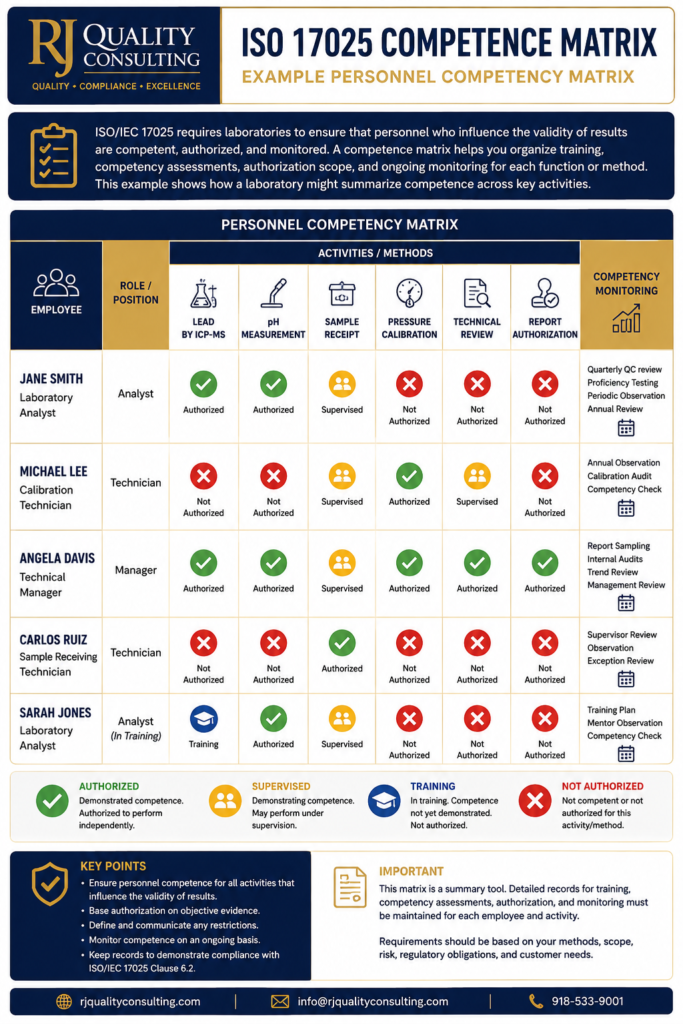
The competence matrix provides a laboratory-wide summary, but it should not replace individual personnel files. When an assessor selects an employee, method, or completed report, the laboratory should be able to retrieve the detailed training record, competency assessment, authorization approval, and ongoing monitoring evidence supporting the status shown in the matrix.
In practical terms, the matrix tells the laboratory who is authorized, while the individual competency record demonstrates why that authorization was granted.
Frequently Asked Questions
If you’re chasing ISO/IEC 17025 accreditation, you’ll run into some pretty specific demands around competency documentation, measurement uncertainty, and quality management. Knowing what you’re up against makes life easier when audit time rolls around—whether it’s internal or with an accreditation body breathing down your neck.
What are the core clauses and requirements in ISO/IEC 17025:2017 for laboratory competence?
The ISO/IEC 17025:2017 standard lays out what you need for lab competence in a handful of main sections. Section 6.2 focuses on staff competency, and you’ll also find stuff about resources, validating methods, and keeping tabs on equipment.
You’ve got to show you run things impartially and stick to solid quality practices. The standard wants you to have procedures for handling nonconforming work and dealing with measurement uncertainty, all written down somewhere.
Competence isn’t just a technical thing. You also need to run a tight quality management ship, with internal checks and regular reviews of your processes.
How to Conduct an ISO 17025 Competency Assessment?
Labs show technical competence in a bunch of ways, mostly through what they do and the documents they keep. You need to validate your methods before using them for any testing or calibration—no winging it.
Jumping into proficiency testing programs gives you hard evidence about how your lab stacks up. If there’s an interlaboratory comparison for your work, you should get involved.
Internal quality controls help you keep tabs on day-to-day performance. You’ll need procedures for figuring out measurement uncertainty and making sure your measurements trace back to SI units.
Validating your methods means you have proof your procedures actually deliver reliable results—so you’ll need documented studies showing you hit the accuracy and precision targets you’re after.
What personnel qualifications, training, and authorization records are expected for competent laboratory staff?
ISO/IEC 17025 asks for documented competence requirements for every job that affects lab activities. You have to spell out what education, qualifications, training, and experience each role needs—no guessing.
Your procedures need to cover six things: figuring out what competence is required, picking the right people, training them, supervising them, authorizing them, and monitoring their competence. You need all this in writing, and you’ve got to keep records too.
Your training records should show exactly how you get staff ready for their jobs. You’ll also need to document how long they’re supervised before you let them loose on their own.
Don’t authorize anyone until you’ve confirmed they’re competent, following your process. After that, keep an eye on their skills with things like peer reviews, proficiency tests, or the occasional assessment.
What equipment control, calibration, and metrological traceability practices are required to support reliable measurements?
Calibrate your equipment regularly, following documented procedures. You’ve got to link your measurements to SI units through a solid chain of calibrations—no gaps allowed.
How often you calibrate depends on the equipment, how much you use it, and what the manufacturer says. Keep records on when you calibrated each item and who did it.
SI traceability gives you (and your clients) confidence in your results. If you can’t get direct SI traceability, make sure you document whatever alternative you’re using.
Your equipment records should list ID, calibration status, and maintenance history. Don’t let anyone use equipment that’s out of calibration or just not up to the task.
What information and requirements must be included on an ISO 17025 calibration certificate?
Calibration certificates have to hit a bunch of marks. You need your lab’s name and address, a unique certificate number, client info, and the date you did the calibration.
The certificate has to describe the calibrated item in enough detail that there’s no confusion. You report the measurement results, including the measurement uncertainty and the conditions during calibration.
If you’re making a statement of conformity, only do it when you’ve checked the item against the right requirements. Spell out the specification and the decision rule you used for that assessment.
Show metrological traceability by referencing the standards you used. Don’t forget signatures and the names of whoever’s responsible for what’s on the certificate.
How can a laboratory use an ISO 17025 checklist to prepare for accreditation and internal audits?
Checklists are your friend when you want to make sure you’re actually following the standard before an external audit. Use them to confirm you’ve got procedures for everything required, and that your records back it up.
Internal audits get a lot easier with structured checklists that cover each part of the standard. Look at things like staff competence records, equipment calibration, and your method validation files.
Checklists help you make sure your test reports and calibration certificates are complete. You’ll want to double-check that your statements of conformity are done right and that you’re including measurement uncertainty where you should.
Using checklists regularly before accreditation visits cuts down on nasty surprises. You’ll spot gaps in your quality system and have a shot at fixing them before someone else points them out.
When you review standard operating procedures (SOPs), checklists help you see if staff are following the docs and if those procedures actually match what you’re doing in real life.
Conclusion
ISO/IEC 17025 puts a big spotlight on personnel competency as a core part of laboratory accreditation. You’ve got to set up real procedures for checking, training, and keeping tabs on your team’s abilities—there’s no way around it.
Your lab needs to actually show that everyone doing testing or calibration knows what they’re doing. That means you’ll want to lay out what’s required for each job and check in regularly to make sure folks still meet those requirements.
When you’re building your competency framework, consider including:
- Initial competency evaluation before anyone jumps into lab activities
- Ongoing training programs to keep skills fresh (and maybe pick up some new ones)
- Regular monitoring of how people are performing
- Documentation for every assessment and training session
Competence really is the backbone of ISO 17025 compliance—there’s just no shortcut.
Your system should cover both technical skills and the ability to stick to your lab’s unique procedures. That’s how you get consistent, reliable results—and honestly, that’s what clients care about.
Competency isn’t something you check off once and forget. As your lab evolves or you roll out new methods, you’ve got to revisit and update qualifications. Keep this cycle going to protect your results and keep your clients’ trust intact.ISO 17025 Clause 7 Process Requirements Explained for Laboratory Compliance
Continue Learning About ISO/IEC 17025
Building or improving your laboratory management system? Continue with these related ISO/IEC 17025 guides.
🕒 Book Your Free 45-Minute Consultation
Have questions about ISO/IEC 17025 or ISO 9001 implementation or accreditation? Schedule a free 45-minute consultation with me to discuss your Company or laboratory’s needs and how we can achieve compliance together.
Schedule Your Consultation